
Hervormde Kerk
Nieuw-Beijerland, NL
This church is listed as a National Monument of the Netherlands.
Here you can search for a building to visit. You can use the map find destinations, or you can use the filters to search for a building based upon what different criteria.
Nieuw-Beijerland, NL
This church is listed as a National Monument of the Netherlands.
Langweer, NL
Reformed Church and Tower. At the western end of the old centre on a fenced churchyard, spacious single-nave church building with tower from 1777. Pilasters on choir closure, west facade and lower tower section; second and third tower section with Ionic and Corinthian pilasters respectively. Above the church entrance, carved window. In the church, oak pulpit from 1684 with back wall and sounding board; baptismal fence with twisted balusters and festoons; oak ball-leg table. Canopied lord's pew; two non-canopied pews; twelve pews with carved end walls. Organ with main work and back work, made in 1784 by Lambertus van Dam on organ balcony with parapet, including back wall with carved panels, all 1784. Copper crown. On the pews, large number of copper candlesticks. Under the wooden floor, number of tombstones. Bell frame with the sound of two bells, one by J. de Bomen, 1438?, diam. 96 cm. and one by P. Overney, 1683, diam. 91 cm. Mechanical tower clock, 18th century.
Haamstede, NL
Reformed church. Rebuilt 16th century after fire around 1500. Crucifix church without choir with open roof turret at the crossing. In the west wall a gate with a basket-handle arch and a large closed arch window. Nave and transept of brick with sandstone corner blocks in the bears. In the basements of the walls on the south side moldings of tufa, originating from an earlier church. Nave covered by a wooden barrel vault and aisles by half-half barrel vaults. Nave separated from transept by a painted partition 19th century. Transept with high closed windows in the north and east side, roofing as in the nave. In use as a consistory and winter church. Board with the name list of ministers. Interior: fragment of a baptismal font of red sandstone. Pulpit 18th century, copper lectern. Baptismal fence 17th century with candle holder. Pew 18th century with alliance coat of arms. Two pews. Three copper crowns around 1700. Board with the name list of ministers. Interior: fragment of baptismal font of red sandstone. Pulpit 18th century, copper lectern. Baptismal fence 17th century with candle holder. Gentlemen's pew 18th century with alliance coat of arms. Two pews. Three copper crowns circa 1700. In the tower on the crosswork is the modern bell from 1950. During the Second World War, a bell from an unknown founder disappeared. A second bell, made in 1532 by Jacob Waghevens, was preserved after the war and was subsequently placed in the church. There is also said (?) to have been a bell by J. van den Ghein from 1532.
Kerkwerve, NL
Neo-church with roof turret. The predecessor of the church dated from the 15th century and was demolished in 1895. After that, a temporary wooden church was in use from 1895 to 1900, which was replaced in 1900 by the current Reformed Church.
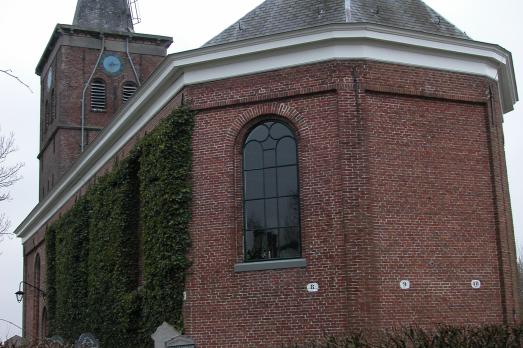
Hoevelaken, NL
Tower. Brick building from the 15th or 16th century, modified in the 19th century in neo-Gothic style. Above the tower entrance the year 1873. Bell frame with the sound of two bells, one of which by J. Tolhuis, 1537, diam. 40.3 cm. and a replica of the clock by W. Both and E. van der Arck. Mechanical tower clock J. van de Kerkhof, Aarle-Rixtel, later fitted with electric winding.
Broek op Langedijk, NL
Dutch Reformed Church. Single-nave late Gothic building, consisting of a nave (16th century) and a narrower 15th century choir. In the west facade above the entrance a pointed arch niche with traceries; above this facade a wooden tower. Pulpit 1709; copper baptismal arch 17th century; Ten Commandments board 1642; three copper crowns; two silver communion cups 1655. Bell frame with bell by Geert van Wou, from 1504.
Drimmelen, NL
Dutch Reformed Church. Founded in 1792 by Jonkvrouw van Doorn, Lady of Drimmelen (commemorated in a stone above the entrance, with coat of arms), to replace the church in Oud-Drimmelen. Hall church, closed on three sides at the short ends; arched windows; high slate roof with roof turret. Internal wooden wall pilasters and wooden barrel vault with two rosettes with mermaids. Adjoining parsonage from the time of construction. Iron entrance gate between two bluestone pillars also from the time of construction. 18th century copper lecterns and baptismal font holder. Restored in 1965.
Engelum, NL
In its current form, the church of Engelum is a three-sided closed hall church with a tower of three sections with a constricted spire. The tower, which is not accessible from the church, was sheathed in 1887 and is said to still have thirteenth-century masonry from the original church. According to the memorial stone in the south wall of the tower (inv. no. 16), the rest of the church was also renovated in 1887. Incidentally, the nave and choir were said to have been rebuilt in 1773.
Elim, NL
Reformed church built in 1916 to a design by architect J. Beijlevelt from Amsterdam. An anonymous donor from the Soest area made the foundation of the church possible through a donation. The peat colony canal village, located in one of the younger development areas, emerged from the foundation of the Reformed Church in 1915.
Noordhorn, NL
Single-nave in construction from the 13th century with a straight choir closure, in which two round-arched windows and parts of recessed panels of the top. In the side walls, there are traces of round-arched windows, entrances and a hagioscope. Strong uncut tower with high spire. In the church pulpit from 1718 with screwed columns and a sounding board. Communion table. Five gentlemen's pews, one with spindle friezes three others with knobs and richly carved rear panels, an 18th-century pew. Three 17th-century tombstones. In the tower bell from 1774. This church is listed as a National Monument of the Netherlands. On 8 November 2002, the restoration of the Dutch Reformed Church began. On Friday 16 January 2004, the church, which dates from 1280, was put back into use. It is striking that the vaults, reminiscent of the Catholic era, have been reinstalled. The gentlemen's pews, which were moved back during the 1978 restoration, are also back in their old place. Furthermore, moisture-resistant measures have been taken. The last service before the restoration was on 17 November 2002. During the restoration, church services were held in the De Wegwijzer community centre.
new
For a long time, Europe was ruled by powerful monarchies. Monarchy and religion have been connected since time immemorial. Here are 7 sites across Europe where royalty historically bent the knee to a higher power and received their crown.
Stupas are symbols of enlightenment and peace that commemorate different stages of Buddha's life. Since the mid-20th century, thousands of stupas have begun to populate Europe. We have compiled some of the most impressive ones in this list.
Walter Maria Förderer (1928–2006) was a Swiss architect and sculptor renowned for his neo-expressionist church designs in the 1960s. In this list we have compiled 6 of his church designs that seamlessly integrate religious and secular elements.