Hervormde Kerk
Hoge Hexel, NL
Reformed church from 1947.

Here you can search for a building to visit. You can use the map find destinations, or you can use the filters to search for a building based upon what different criteria.
Hoge Hexel, NL
Reformed church from 1947.
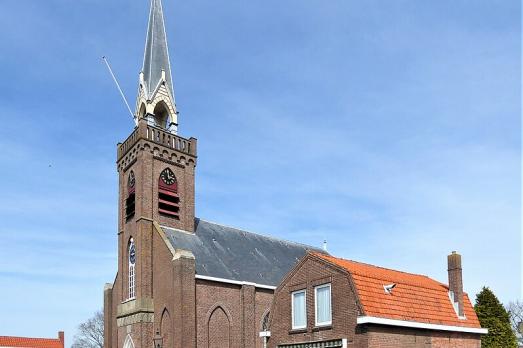
Arnemuiden, NL
The chronicler Reigersberg writes that on 9 May 1505 the first stone was laid for a new church, a cruciform church. That church was put into use in 1545 and dedicated to Saint Martin.
Kesteren, NL
New church, the old church was destroyed by war. The historic tower was preserved. Oak pulpit, second quarter 17th century with copper lectern and baptismal font arm; a 17th century chandelier and several 17th century tombstones.
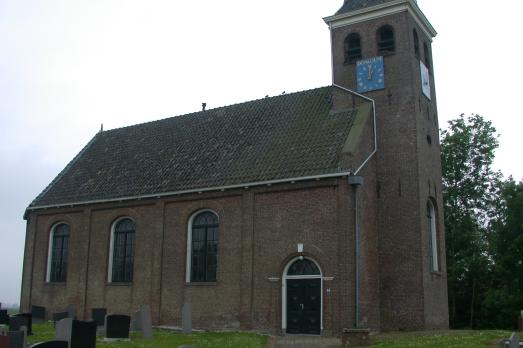
Dongjum, NL
Reformed Church and tower on churchyard. In 1777 rebuilt brick church with tower.
Oude Wetering, NL
The Reformed Church of Oude and Nieuwe Wetering originally belonged to the church in Leimuiden. The first minister, Rev. Johan Vossius, was there from 1578–1579. Single-nave church on a T-shaped plan, created by expanding a small church built parallel to the road in 1691 with a wing perpendicular to it in 1843. Hexagonal wooden bell tower at the intersection of the roofs. In the church covered by wooden barrel vaults a pulpit, late 17th century, with a carved coat of arms on the sounding board and a copper lectern from 1696. Furthermore a carved organ case from 1784 and two psalm boards in a carved frame, around 1700. This church is listed as a National Monument of the Netherlands.
Gerkesklooster, NL
The church is a remnant of a Premonstratensian monastery founded in 1240 by a certain Gerke Harkema from Augustinusga , the Jerusalem monastery. In 1580 the monastery was largely demolished, only the fifteenth century brewhouse remained. In 1629 this was converted into a church, part of it was given the function of a residence for the minister in 1786. The tower is 19th century.
Kootwijkerbroek, NL
Large reconstruction church with tower; a "Refodome".
Siddeburen, NL
The oldest, Romanesque, part is the base of the tower and the two westernmost bays. This part was built around 1200. A few decades later, the building was extended in Romanesque Gothic style, with a recessed semicircular apse being built on the east side. The beautiful brickwork was hidden for years by a layer of plaster. Halfway through the 20th century, the church was restored, with the brickwork being made visible again. (Source: [1] )
Sleeuwijk, NL
The Reformed Church of Sleeuwijk has existed since 1618. For centuries, church services were held in the 'Old Church' at Kerkeinde, a few kilometres outside the village.
Garderen, NL
Neo-Gothic straight-closed hall church from 1859, replacing a medieval predecessor, which was originally dedicated to St. Gangulphus. The tower dates from the early 14th century and was raised with a section in the 15th century. The spire dates from the 18th century. The main user of this church building since 2004 has been the Restored Reformed Church.

new
For a long time, Europe was ruled by powerful monarchies. Monarchy and religion have been connected since time immemorial. Here are 7 sites across Europe where royalty historically bent the knee to a higher power and received their crown.

Stupas are symbols of enlightenment and peace that commemorate different stages of Buddha's life. Since the mid-20th century, thousands of stupas have begun to populate Europe. We have compiled some of the most impressive ones in this list.

Walter Maria Förderer (1928–2006) was a Swiss architect and sculptor renowned for his neo-expressionist church designs in the 1960s. In this list we have compiled 6 of his church designs that seamlessly integrate religious and secular elements.

How is Religiana helping to conserve and promote Religious Heritage in Europe and why should you get involved?
Find out about Religiana
Are you a tourism organisation or religious heritage sites manager? Discover the advantages of becoming a partner.
See current partners
We can keep you up to date with the latest news from Religiana and religious heritage conservation across Europe.
Sign up to the FRH newsletter