
Explore Religious Heritage Across Europe

Here you can search for a building to visit. You can use the map find destinations, or you can use the filters to search for a building based upon what different criteria.

Refine search

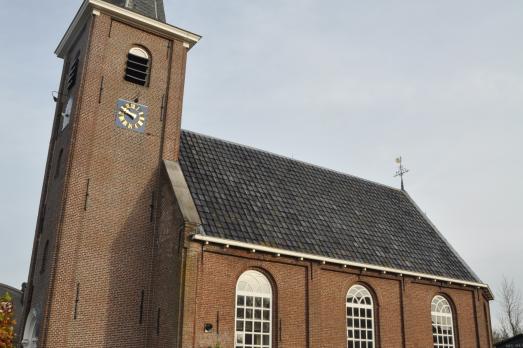
Hervormde Kerk

Hervormde Kerk

Earnewâld, NL

Reformed Church and tower, situated on a churchyard. Simple village church from 1774. The church contains a richly carved pulpit with a rear bulkhead and sounding board from 1699. The organ was made in 1874 by L. van Dam and Sons. It has a bell tower with a bell by G. van Wou, from the 1500s. The mechanical tower clock was made by Gebr. van Bergen in 1918.

Hervormde Kerk

Longerhouw, NL

Church building rebuilt in the 18th century with upright tower of small yellow stone. Interior richly carved pulpit tub with rear bulkhead, sounding board; baptismal fence, all mid-18th century. Organ with main work and upper work, made in 1868 by L. van Dam and Sons. Bell tower with bell by JN Derck, 1742, diam. 95 cm.

Hervormde Kerk

Bruinisse, NL

Interesting reconstruction church with roof turret. Replaced a historic church destroyed by war.

Hervormde Kerk

Glanerbrug, NL

Nice neo-romanesque church with saddle roof tower in Glanerbrug. Restoration second half 2000s.

Hervormde Kerk

Oudega, NL

Simple, mid-19th century single-nave church dating from 1850. It is situated on a mound and surrounded by a churchyard, built of yellow Frisian stone; the whole is closed on three sides, is covered by a saddle roof covered with blue tiles and crowned by a turret of a more recent date (19th century) with a constricted spire with tower cock that is equipped with coupled sound holes with dividing columns. This church is listed as a National Monument of the Netherlands.

Hervormde Kerk

Beusichem, NL

Three-aisled pseudo-basilica with five-sided closed choir from the 15th century with a tower of which the lower four sections are still 12th century. Internal wooden barrel vaults. Replaced an older church. Beautiful tuff stone tower (ca. 1200) of the Reformed Church, raised with a brick floor in the Gothic period.

Hervormde Kerk

Herkingen, NL

The polder Oud-Herkingen was probably first diked in 1420. At that time, this polder belonged to the monastery of the Regulars of Rugge in Brielle and to the Carthusian monastery in Zelem. These monasteries rented the polder to shepherds. This polder did not exist for long. In 1484, Herkingen was diked again. On 9 July of the same year, the chapel that had been built was elevated to parish church by the bishop of Utrecht, David of Burgundy. The chapel was dedicated to Saint Cornelius and was incorporated into the monastery of the Regulars of Rugge. This polder did not exist for long either, because a flood was already reported in 1511. The chapel that had been built was probably washed away. Many floods would follow in the 16th century.

Hervormde Kerk

Hollandscheveld, NL

Dutch Reformed Church. Straight-ended neoclassical hall church, consecrated on 26 December 1850, with a facade tower with openwork lantern and constricted spire.

Hervormde Kerk

Opijnen, NL

Plastered church building from 1860. The church is a three-sided closure, internal cove ceiling. The inventory includes: a richly carved pulpit in transitional forms Louis XIV-Louis XV, dated on the sounding board; 1744. Lectern and baptismal font holder. Otherwise complete inventory from the construction period; reader's chair, lord's pew, wainscoting with copper wall arms, all circa 1860. Two-manual organ, made in 1859 by H. Knipscheer. The free Pedal made in 1947 is not protected. This church is listed as a National Monument of the Netherlands.

Hervormde Kerk

Colijnsplaat, NL

Hall church with tower. Built as a Reformed church. Enlarged 1615, rebuilt 1769.

Be inspired

Stupkalnis.lt

10 Buddhist stupas to discover in Europe

Stupas are symbols of enlightenment and peace that commemorate different stages of Buddha's life. Since the mid-20th century, thousands of stupas have begun to populate Europe. We have compiled some of the most impressive ones in this list.