Explore Religious Heritage Across Europe

Here you can search for a building to visit. You can use the map find destinations, or you can use the filters to search for a building based upon what different criteria.

Refine search

Hervormde Kerk

Oldemarkt, NL

In 1448 a chapel was built on this site. In 1850 it was expanded with a side aisle on the south side. This side aisle was demolished again in 1970-1973, during the restoration. As a result, the church regained its original form. For the construction of the chapel at that time, a certain Jacob Muerling, who had many possessions in Oldemarkt, made a considerable effort by donating lands to the church. The parish church was at that time in Paaslo. In 1489, the parish church was transferred to Oldemarkt. This church is listed as a National Monument of the Netherlands.

Hervormde Kerk

Niawier, NL

In 1678 rebuilt church from old material; framed entrance on the north side with stone inscription concerning the construction. In the church simple pulpit XVIII, four 17th century gravestones, two text boards as in Aalsum. Single manual organ, made in 1818 by JA Hillebrand. The 13th century clock has been transferred to the Friesch Museum in Leeuwarden. Mechanical wrought iron tower clock, has been decommissioned.
Hervormde Kerk

Kloosterhaar, NL

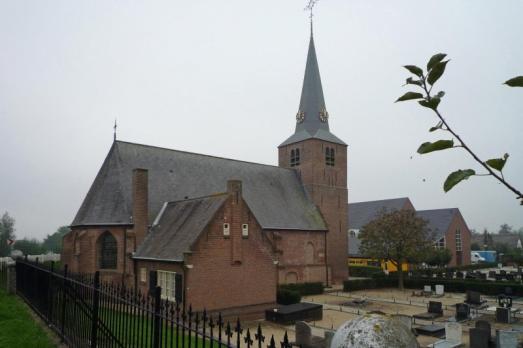
The church replaced a smaller church from 1892. Striking and quite rare example of reformed church building from the reconstruction period in traditionalist forms.

Hervormde Kerk

Oosterwijk, NL

Reformed Church from 1872. It has a pulpit from the last quarter of the 17th century and two 18th-century copper crowns. This church is listed as a National Monument of the Netherlands.

Hervormde Kerk

Sint-Kruis, NL

In 1296, a parish in Sint Kruis was first mentioned, which was subordinate to the Ter Doest Abbey. Due to flooding, partly as a result of the Geuzen breaching the dikes in 1584 to stop the Spanish troops, the area was flooded and was not drained again until 1651. The current church building dates largely from the 14th century and initially consisted of a single-nave church with a tower. In 1467 and 1483, the church was enlarged to a three-nave church with a choir and transept. This church was badly damaged during the Dutch Revolt, but in 1652 it was restored to serve as a Reformed church building. What remained was a single-nave church with a straight-ended nave and the tower. Another renovation took place in 1872. In 1944, the church was badly damaged by war violence and was restored in 1948-1949.

Hervormde kerk (former Trudokerk)

Hervormde kerk (former Trudokerk)

Aalburg, NL

The Trudokerk was founded in 1100 under the authority of the Abbey of Sint Truiden (Belgium). It is the oldest church in the region of Land van Heusden en Altena.

Hervormde Kerk Got Tjark

Schiermonnikoog, NL

Reformed church. Straight-ended hall church from 1866 on the site of the old church from 1762. Above the front facade a wooden facade tower with spire. All facades have round-arched windows. After restoration in 1916 a major restoration followed in 1967 during which the interior was significantly changed. Pulpit from 1866. Organ by J. Proper from 1897, originating from Culemborg and placed in this church in 1927. The bell dates from 1989 and was made by Eijsbouts in Asten (NBr.). It replaces the bell that was made by Jacob Noteman in Leeuwarden in 1649 and is now, being torn, on display in the hall of the town hall of Schiermonnikoog.

Herz-Jesu Residential

Herz-Jesu Residential

Mönchengladbach, DE

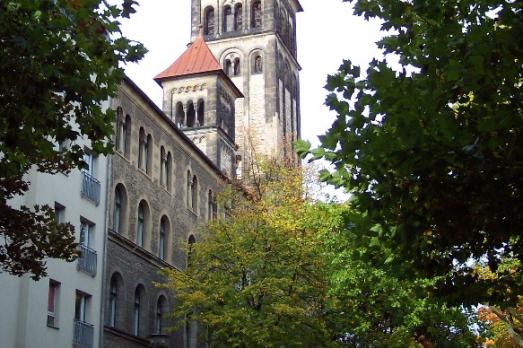
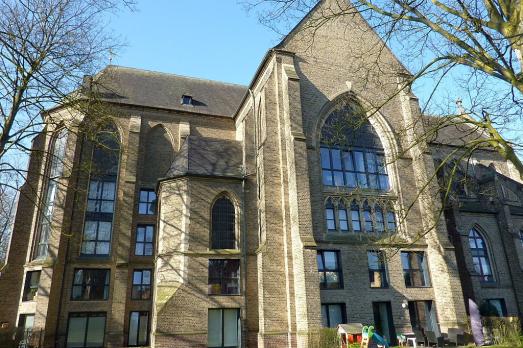
The Catholic Parish Church of St. Peter in Mönchengladbach, Germany, underwent a transformation into publicly funded apartments. Designed by Josef Kleesattel, the neogothic church retained its monumental character while accommodating a socially diverse community with affordable rents.

Herz-Jesu-Kirche

Herz-Jesu-Kirche

Berlin, DE

The Sacred Heart Church is a Catholic church that was built between 1897 and 1898 by the architect Christoph Hehl. At the end of the 19th century, the urban expansion of Berlin necessitated the construction of new places of worship. As the future district of Prenzlauer Berg was not very dense, the only notable pre-existing buildings were windmills and inns. One of these inns was purchased in 1890 by the parish of St. Hedwig to build a chapel, together with the adjacent presbytery and a Catholic school.

Herz-Jesu-Kirche

Herz-Jesu-Kirche

München, DE

Herz-Jesu-Kirche was built in the years 1997 to 2000 according to the plans of the Munich Allmann Sattler Wappner architectural office. The modern building is located on an old church, burned down in 1994, itself a replacement for a church destroyed during the Second World War. Herz-Jesu-Kirche is one of the most visited churches in Munich.

Be inspired

Stupkalnis.lt

10 Buddhist stupas to discover in Europe

Stupas are symbols of enlightenment and peace that commemorate different stages of Buddha's life. Since the mid-20th century, thousands of stupas have begun to populate Europe. We have compiled some of the most impressive ones in this list.