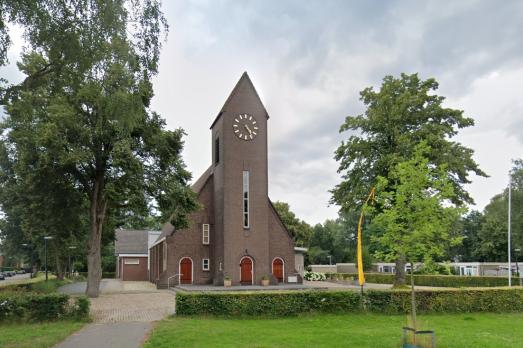
Hervormde Kerk
Best, NL
Built as a Dutch Reformed Church in the Wilhelminadorp district, in the south of Best..
Here you can search for a building to visit. You can use the map find destinations, or you can use the filters to search for a building based upon what different criteria.
Best, NL
Built as a Dutch Reformed Church in the Wilhelminadorp district, in the south of Best..
Kloosterhaar, NL
The church replaced a smaller church from 1892. Striking and quite rare example of reformed church building from the reconstruction period in traditionalist forms.
Didam, NL
The Reformed Church in Didam worshipped in the old Mariakerk until 1951. Because this building was much too large, it was sold to the Roman Catholic parish in that year, and a small new church was built. In 1956, Van Vulpen delivered a new organ for this church. The instrument is almost identical to the organ that Van Vulpen placed at the World Exhibition "Expo 1958" in Brussels two years later. E. Verschueren from Tongeren (B) carried out revision work in 1974. Various changes were made: the pedal was placed in its own case against the back of the church on a larger new wind chest. The Vox Humana 4' of the pedal was replaced by a Fagot 16'. Verschueren adjusted the intonation of the organ and remedied the 'spucking'. Finally, the composition of the Scherp was adjusted. Hans Kriek was the advisor for the work. In the years that followed, Hans Kriek made several changes: the Scherp was changed into a Mixtuur, placed on a raised bench, in order to improve accessibility during tuning. The Quint 1 1/3' was moved up to 2 2/3'. Instead of the Cimbel, a Terts 1 3/5' from c.° was introduced. The Fagot 16', which contributed little to the total sound, was replaced by a stronger register. Since 1 May 2004, the church has been in use by the Protestant Community of Didam.
Stavenisse, NL
NH Church from 1910, placed on the list of monuments because of interior components: Tomb monument of Tuyl van Serooskerken (approx. 1670) made by Rombout Verhulst. Tomb with reclining figure, the back wall decorated with quarters and putti. Pulpit with Ionic pilasters on the corners of the bowl. XVIId. Reader's pew and regent's bench from the same period.
Nieuw-Beijerland, NL
This church is listed as a National Monument of the Netherlands.
Made, NL
The Reformed Church of Made is a late Gothic building. The church was founded in 1511 although the building has suffered several alterations in different periods.
Rijswijk, NL
The church of Rijswijk is mentioned in 1369 when Willem VI van Horne, Lord of Altena, gives goods in fief to Vastraet van Giessen, including the ferry of Andel that lies between "Veenregraven" and the church of Rijswijk. From the church visitations of Bishop Metsius it can be concluded that the church is dedicated to St. Stephanus. Historians estimate this church to be very old. During research and excavations, the foundations of a tuff stone hall church from around 1100 were exposed, with a tower on the west side. This old church must have been badly damaged by the many floods of the Maas in the middle of the 13th century. The restoration will have taken place around 1265, after the church hill was first raised considerably. The battle against the water appears to be an eternal one for the church. After repairs were made with great difficulty in the 16th century, the old church succumbed during the flood of 1809. The church was demolished down to its tuff foundation. Much later, a new church was built on the same site, of which the following was written in the middle of the 19th century: "The church stands outside the dike in the Rotgans. It is old and not very large and has a long tower, flat-roofed on top, but is not equipped with an organ. The choir has completely collapsed, except for a few pieces of dilapidated masonry."
Maasdam, NL
Charming, eclectic village church with tower. Built to replace its demolished predecessor .
Sint-Kruis, NL
In 1296, a parish in Sint Kruis was first mentioned, which was subordinate to the Ter Doest Abbey. Due to flooding, partly as a result of the Geuzen breaching the dikes in 1584 to stop the Spanish troops, the area was flooded and was not drained again until 1651. The current church building dates largely from the 14th century and initially consisted of a single-nave church with a tower. In 1467 and 1483, the church was enlarged to a three-nave church with a choir and transept. This church was badly damaged during the Dutch Revolt, but in 1652 it was restored to serve as a Reformed church building. What remained was a single-nave church with a straight-ended nave and the tower. Another renovation took place in 1872. In 1944, the church was badly damaged by war violence and was restored in 1948-1949.
Apeldoorn, NL
Due to the strong growth, especially on the western side of Apeldoorn and the associated increase in the number of inhabitants, the Reformed Church built a new church on the Asselsestraat in 1934.
new
For a long time, Europe was ruled by powerful monarchies. Monarchy and religion have been connected since time immemorial. Here are 7 sites across Europe where royalty historically bent the knee to a higher power and received their crown.
Stupas are symbols of enlightenment and peace that commemorate different stages of Buddha's life. Since the mid-20th century, thousands of stupas have begun to populate Europe. We have compiled some of the most impressive ones in this list.
Walter Maria Förderer (1928–2006) was a Swiss architect and sculptor renowned for his neo-expressionist church designs in the 1960s. In this list we have compiled 6 of his church designs that seamlessly integrate religious and secular elements.