Explore Religious Heritage Across Europe

Here you can search for a building to visit. You can use the map find destinations, or you can use the filters to search for a building based upon what different criteria.

Refine search

Laurentiuskerk

Kimswerd, NL

Reformed Church. Very old (12th century) tuff stone church building with somewhat younger brick choir. Tower below made of tuff stone, raised in 1516. Above the northern entrance a relief of red sandstone from the 12th century. Southern entrance through a gate from 1516. Beautiful interior according to a memorial plaque from 1695, consisting of panelling, choir fencing, pews with carved cheek pieces, pulpit with baptismal fence; furthermore a family pew. Tiara and van Heemstra, memorial plaque of Heemstra, with painted coat of arms, portrait of Ida van Heemstra and coat of arms plaque and memorial plaque from 1798. Gravestone of Heemstra's by Jacob Lous 1614. Organ made in 1858 by W. Hardorff.

Laurentiuskerk

Ginneken, NL

In 1261 there was mention of a chapel, and since 1316 there was mention of an independent parish in the village of Ginneken, which was dedicated to Saint Lawrence. The oldest parts of the current building are however late Gothic and date from the middle of the 15th century. It is a single-nave cruciform church with a west tower. In 1630 there was a fire that destroyed a large part of the church, but the choir and transept were preserved. There was also a fire in 1649. The church was restored in 1928 and in 1940 the nave was rebuilt. The built-in tower dates from the 14th century and was changed in 1649 .

Laurentiuskerk

Raerd, NL

Reformed church and tower on a spacious enclosed churchyard. Church with tower rebuilt in 1814. The church has a beautiful 18th century inventory, namely pulpit with stairs, rear bulkhead and sounding board and lectern, baptismal fence with coat of arms panel, three singing boards, two blocks of benches with carved cheek pieces and crowns; two covered benches against the side walls, four large 16th and 17th century tombstones, against the tower wall two 16th century. Two richly carved and a simpler mourning board. Two-manual organ made in 1816 by JA Hillebrand, modified in 1863 by L. van Dam and Sons, on a balustrade with carvings. In 2012 the organ was restored by the Reil company and the case was painted white. Bell tower with bell by JN Derck, 1762, diam. 131 cm. Mechanical tower clock G. de Looze, Leeuwarden, 1894, later equipped with electric winding.

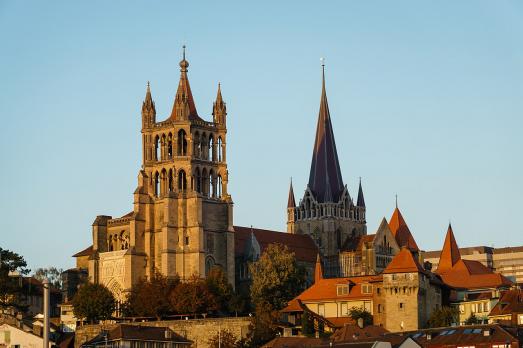
Lausanne Cathedral

Lausanne Cathedral

Lausanne, CH

Lausanne Cathedral, built between 1170 and 1235, is one of the most important Gothic monuments in Switzerland. In the Middle Ages, it became an important place of Marian pilgrimage, attracting up to 70,000 people a year. Pilgrimages ceased when the cathedral became Protestant in 1536 and the silver-gilt statue of the "enthroned Virgin with Child" was melted down. In its present state, the church dates largely from the complete restoration of 1892-1909.

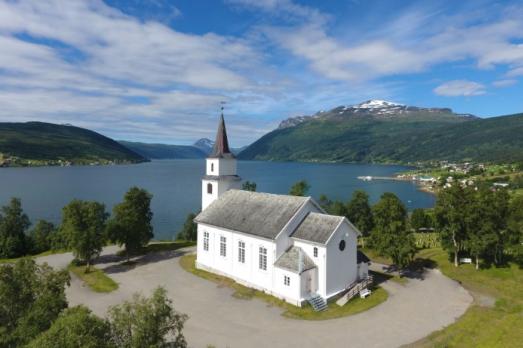
Lavangen Church

Lavangen Church

Tennevoll, NO

The Lavangen church is a half-timbered church built by the builder O. Scheistrøen. It was consecrated in 1891 as a chapel in the parish of Ibestad, after which it was also attached to the parish of Salangen before it became its own parish.

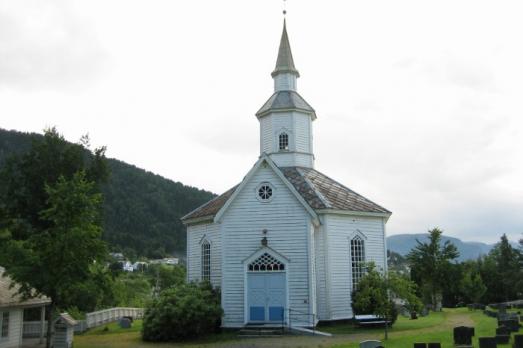
Lavik Church

Lavik Church

Høyanger, NO

The Lavik church is an octagonal church built in 1865 according to the plans of the architect Christian Heinrich Grosch and is made of wood. Today's church is the third known church in the town. The first was a stave church which probably dates from the 12th century. The stave church was replaced by a new church in 1594, which in turn was replaced by the present church from 1860 onwards.

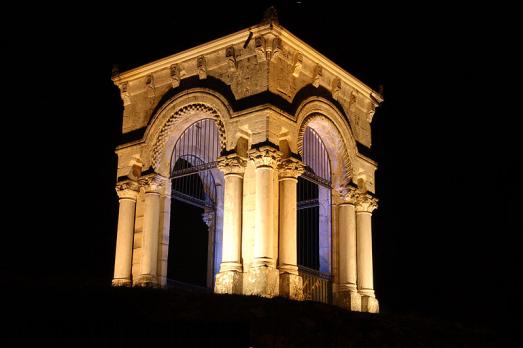
Le Calvaire

Le Calvaire

Vals-les-Bains, FR

It is a certain Malmazet, a Protestant surgeon of his state, who in 1732, had this calvary erected. Afflicted by a serious illness, he vowed to convert to Catholicism once he was cured. He then made a pilgrimage to Jerusalem, from which he brought back a marvellous memory. The disposition of the promontory between the Volane and its tributary the Voltour seemed to him to be favourable for the reconstitution of the Calvary of Jerusalem. From afar, the aedicule has retained its elegance. Every Good Friday, the parishioners perform the Way of the Cross beautifully illustrated by a local artist. The Calvary, damaged during the Revolution, was rebuilt in 1863.

Le Mans Cathedral

Le Mans Cathedral

Le Mans, FR

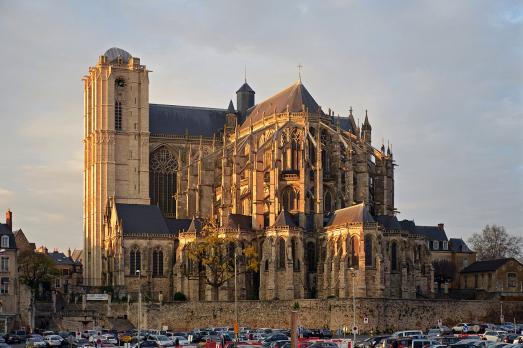
Following a first foundation, the construction of the current cathedral began in the 1060s under Bishop Vulgrin, then the choir, transept and towers were under construction at the end of the 11th century. The cathedral was consecrated in 1158, thus rebuilt under William of Passavant following fires. It was also in the 12th century that it received its sculpted portal. The choir was rebuilt in the 13th century. The transept was in turn rebuilt between 1385 and 1430.

Lead Mosque

Lead Mosque

Berat, AL

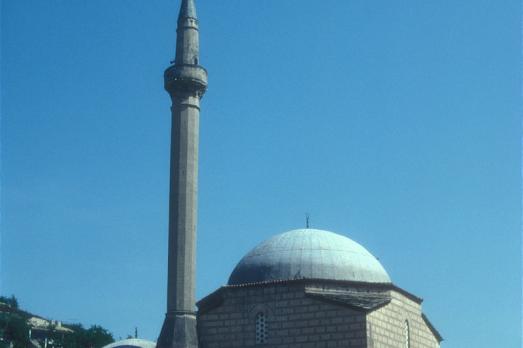
Also known as the Izgurli Mosque, it was founded in the 16th century. The dome of the mosque is covered with lead coat, hence the nickname.

Lead Mosque

Lead Mosque

Shkodër, AL

Like its conterpart in Berat, this Lead mosque got its nickname due to the lead covered dome. It is also known as Buşatlı Mehmet Pasha Mosque.

Be inspired

Stupkalnis.lt

10 Buddhist stupas to discover in Europe

Stupas are symbols of enlightenment and peace that commemorate different stages of Buddha's life. Since the mid-20th century, thousands of stupas have begun to populate Europe. We have compiled some of the most impressive ones in this list.