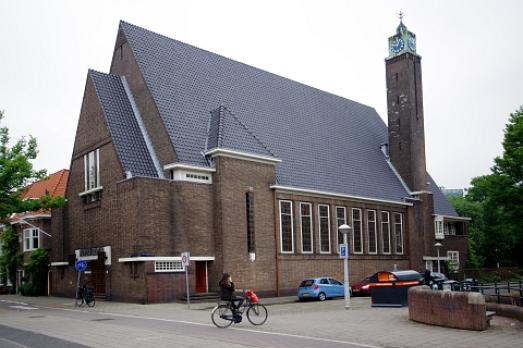
Nieuw Apostolische Kerk
Leeuwarden, NL
Interesting early modern complex, without a tower.

Here you can search for a building to visit. You can use the map find destinations, or you can use the filters to search for a building based upon what different criteria.
Leeuwarden, NL
Interesting early modern complex, without a tower.
Haren, NL
Beautiful modern church without a tower.
Amsterdam, NL
Built as a New Apostolic church. As such out of use around 1990. Now in use as the Moroccan An Nour mosque.
Blokker, NL
Beautiful modern church, somewhat in the form of a North Holland farmhouse, with, among other things, series of stained glass windows. Replaced previous church locations of the New Apostolic Community of Hoorn and surroundings. Remarkably, unlike almost all other NAP churches, the well-known emblem is not placed on the front facade, but on top of the roof.
Emmeloord, NL
The New Jerusalem Church in Emmeloord was built as a Reformed Church. Willem van Leeuwen delivered an organ in 1955. It was restored by Kaat & Tijhuis in 1982. The Mixture of the Main Work was changed by them from VI-VIII strong to IV strong. The church building has been in use as a PKN church since June 2006. The organ was overhauled in 2008. The Ruispijp IV strong of the pedal was replaced by a Roerquint 5 1/3', probably by the firm Kaat & Tijhuis, who also maintain the organ. A few years later, the Octaaf 2' of the Rugwerk and the Nachthoorn 2' of the Main Work were swapped.
Hurdegaryp, NL
Built as a Reformed Church. Later expanded. Hall church with roof turret.
Amstelveen, NL
Built in 1965 , this church is located in North Holland.
Scheveningen, NL
Built as Dutch Reformed Church, replacing the earlier Badkapel, elsewhere in Scheveningen. Extremely important, monumental church building on the ground plan of a Greek cross, built in 1915-1916 to a design by W.Ch. Kuijper jr. The church has two large towers, placed in the armpits of the main nave and transepts. They are crowned by an octagonal structure with helmet-shaped copper roofs. A small dome-shaped crowning on the crossing. Striking entrance with arcades, the arched theme of which recurs in various places in the building. Very large windows in the gables of the four arms, provided with traceries in natural stone and brick. They contain stained-glass figurative glass. The wooden roofs are provided with decorative painting on the inside. In addition to the organ gallery, the church has deep galleries with ascending pew arrangement in the other three naves. The benches on the galleries date from the construction period, those on the ground floor were replaced later. Many interior components from the construction period were preserved; the baptismal fence and church council benches have disappeared. In 1989, new liturgical furniture was placed around the pulpit, the design of which was adapted to the pulpit.
Ermelo, NL
Large cross-shaped church with corner tower in business-expressionist style. 2009 renovation interior, especially ceilings and grounds outside.
Ede, NL
Important, well-preserved, large interbellum church with a roof turret at the crossing.

new
For a long time, Europe was ruled by powerful monarchies. Monarchy and religion have been connected since time immemorial. Here are 7 sites across Europe where royalty historically bent the knee to a higher power and received their crown.

Stupas are symbols of enlightenment and peace that commemorate different stages of Buddha's life. Since the mid-20th century, thousands of stupas have begun to populate Europe. We have compiled some of the most impressive ones in this list.

Walter Maria Förderer (1928–2006) was a Swiss architect and sculptor renowned for his neo-expressionist church designs in the 1960s. In this list we have compiled 6 of his church designs that seamlessly integrate religious and secular elements.

How is Religiana helping to conserve and promote Religious Heritage in Europe and why should you get involved?
Find out about Religiana
Are you a tourism organisation or religious heritage sites manager? Discover the advantages of becoming a partner.
See current partners
We can keep you up to date with the latest news from Religiana and religious heritage conservation across Europe.
Sign up to the FRH newsletter