Nieuwe Kerk
Putten, NL
Built as Dutch Reformed Church. Reconstruction church with roof turret. From 2009 to early 2010s in shared use by the Restored Reformed Church.

Here you can search for a building to visit. You can use the map find destinations, or you can use the filters to search for a building based upon what different criteria.
Putten, NL
Built as Dutch Reformed Church. Reconstruction church with roof turret. From 2009 to early 2010s in shared use by the Restored Reformed Church.
Huizen, NL
Important interbellum church with tower. Renovated 1993. Reformed Federation church.
Ermelo, NL
Large cross-shaped church with corner tower in business-expressionist style. 2009 renovation interior, especially ceilings and grounds outside.
Delft, NL
Originally built as Roman Catholic St. Ursula Church. Extremely important historical church building with high tower. The tower is the second highest church tower in the Netherlands, 109 m (the Dom in Utrecht is the highest at 112 m).
Den Helder, NL
Large neoclassical hall church ("water board style"). Built as Dutch Reformed New Church. Wooden tower from 1843. Important design by architect HH Dansdorp, whose main work is the neoclassical Roman Catholic St. Joseph Church in Haarlem. Decommissioned as Dutch Reformed Church in the early 1970s.
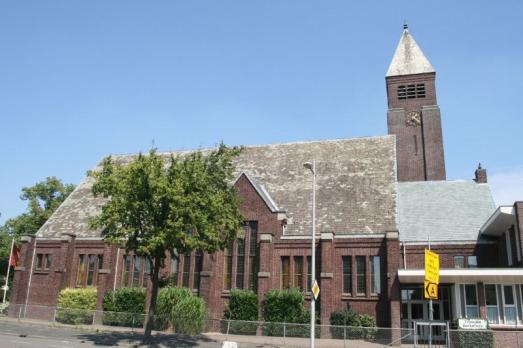
Amersfoort, NL
Interesting interbellum church with a tower placed on the side. Built as the Dutch Reformed Church. This church building looks very much like the (still existing) Dutch Reformed New Church in Huizen.
Borne, NL
The church was the second reformed church of Borne and is located in the western extension. Characteristic example of protestant church building from the interbellum. The church has recently been renovated internally and externally (see photos).
Ede, NL
Important, well-preserved, large interbellum church with a roof turret at the crossing.
Kampen, NL
Church building in the shape of a Greek cross built in clean brickwork under saddle roofs covered with grey clay tiles. Front facade (O) with a central risalit that suggests a three-aisled church. The risalit is closed off by corner pilasters with natural stone cover plates and is provided with a drip moulding. Centrally placed entrance under a round arch with archivolts. The wooden doors with iron fittings are under a natural stone calf with a vertically divided, round-arched fanlight above it. Above the entrance three high round-arched windows with stained glass. In the top a small round-arched window. The side facades of the risalit contain doors under segmental arches with sandstone springers. In the recessed parts of the front facade are small round-arched windows. Side facade (S) consisting of a projecting facade section on the left (the end facade of a transept arm) and a recessed facade section on the right with a four-sided chapel. In the recessed part of the facade and the chapel several round arch windows. In the risalit an entrance under a round arch, above which a very large round arch window with stained glass is placed. The northern transept arm also contains such a round arch window. In the rear facade several small round arch windows. Fairly sober INTERIOR with balconies, supported by natural stone columns with Corinthian capitals and galleries. Panelled ceiling with ceiling beams supported by corbels. Original pulpit consisting of a marble base with wooden superstructure.
IJmuiden, NL
Architecturally extremely important, unique, neo-Gothic church building with roof turret in Anglican (English) style. This church has been preserved intact amidst much destruction and post-war deforestation in the rest of IJmuiden, also destruction and demolition of many churches. In use as a church of a separate Reformed Church IJmuiden-West, with ± Reformed Bond signature, within the PKN.

new
For a long time, Europe was ruled by powerful monarchies. Monarchy and religion have been connected since time immemorial. Here are 7 sites across Europe where royalty historically bent the knee to a higher power and received their crown.

Stupas are symbols of enlightenment and peace that commemorate different stages of Buddha's life. Since the mid-20th century, thousands of stupas have begun to populate Europe. We have compiled some of the most impressive ones in this list.

Walter Maria Förderer (1928–2006) was a Swiss architect and sculptor renowned for his neo-expressionist church designs in the 1960s. In this list we have compiled 6 of his church designs that seamlessly integrate religious and secular elements.

How is Religiana helping to conserve and promote Religious Heritage in Europe and why should you get involved?
Find out about Religiana
Are you a tourism organisation or religious heritage sites manager? Discover the advantages of becoming a partner.
See current partners
We can keep you up to date with the latest news from Religiana and religious heritage conservation across Europe.
Sign up to the FRH newsletter