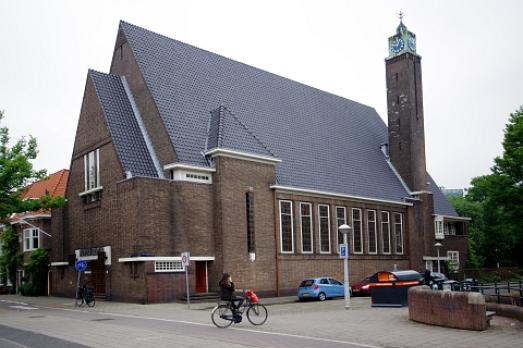
Nieuw Apostolische Kerk
s-Gravenhage, NL
Modern church without tower. In 2007-2009 extensively renovated.
Here you can search for a building to visit. You can use the map find destinations, or you can use the filters to search for a building based upon what different criteria.
s-Gravenhage, NL
Modern church without tower. In 2007-2009 extensively renovated.
Hoogezand, NL
In the early seventies of the twentieth century, the two churches of the New Apostolic Church in Hoogezand and Sappemeer were too small to accommodate the number of members. It was decided to build a third church in the new residential areas in the southwest of Hoogezand. The architect was WC van Asperen from Rotterdam. The church was put into use in 1972. In 1981, the church was partly destroyed by fire and put into use again in 1982. In 2010, the congregation was merged with the congregation on the Noordersingel in Hoogezand.
Emmeloord, NL
The old building was demolished and a new church was built on the same site.
Amsterdam, NL
Former New Apostolic Church in the Netherlands. Interesting church building with two small rectangular towers, on either side of the front facade. Out of use as a church in the 1990s, after which apartments were built in. The front facade has remained almost completely intact.
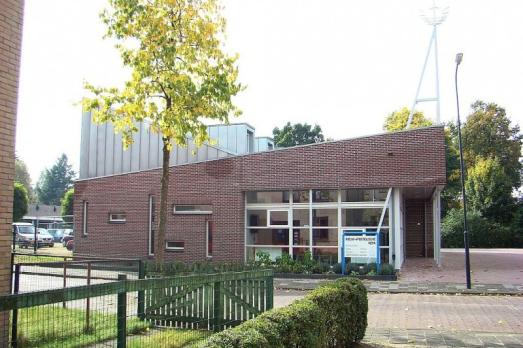
Emmeloord, NL
The New Jerusalem Church in Emmeloord was built as a Reformed Church. Willem van Leeuwen delivered an organ in 1955. It was restored by Kaat & Tijhuis in 1982. The Mixture of the Main Work was changed by them from VI-VIII strong to IV strong. The church building has been in use as a PKN church since June 2006. The organ was overhauled in 2008. The Ruispijp IV strong of the pedal was replaced by a Roerquint 5 1/3', probably by the firm Kaat & Tijhuis, who also maintain the organ. A few years later, the Octaaf 2' of the Rugwerk and the Nachthoorn 2' of the Main Work were swapped.
Hurdegaryp, NL
Built as a Reformed Church. Later expanded. Hall church with roof turret.
Amstelveen, NL
Built in 1965 , this church is located in North Holland.
Scheveningen, NL
Built as Dutch Reformed Church, replacing the earlier Badkapel, elsewhere in Scheveningen. Extremely important, monumental church building on the ground plan of a Greek cross, built in 1915-1916 to a design by W.Ch. Kuijper jr. The church has two large towers, placed in the armpits of the main nave and transepts. They are crowned by an octagonal structure with helmet-shaped copper roofs. A small dome-shaped crowning on the crossing. Striking entrance with arcades, the arched theme of which recurs in various places in the building. Very large windows in the gables of the four arms, provided with traceries in natural stone and brick. They contain stained-glass figurative glass. The wooden roofs are provided with decorative painting on the inside. In addition to the organ gallery, the church has deep galleries with ascending pew arrangement in the other three naves. The benches on the galleries date from the construction period, those on the ground floor were replaced later. Many interior components from the construction period were preserved; the baptismal fence and church council benches have disappeared. In 1989, new liturgical furniture was placed around the pulpit, the design of which was adapted to the pulpit.
Haarlem, NL
New Church. Beautiful tower built in 1613 by Lieven de Key against the older St. Anna Church, which was replaced in 1645-1649 by the current one designed by Jacob van Campen, stone with inscription east facade. The church is a sober hall building with a wide rectangular floor plan, wider than its predecessor in little harmony with the tower. Internally divided by four pillars in a Greek cross with wooden barrel vaults and the quadrangular sections of flat ceilings. Beautiful prayer room - poor modern glazing. Freestanding pulpit, square tub from the construction period. Originally a choir organ of the St. Bavo in Haarlem, made in 1523 by J. van Covelen. In 1791 transferred to the New Church by HH Hess. He made a new two-manual instrument using much pipework from the older organ. The Pedal was installed on either side of the organ in 1862 by H. Knipscheer. Restored by Van Vulpen in 1985. Bell frame with clock by Cyprianus Crans, 1749, diam. 98 cm. Mechanical tower clock, 1795.
Kampen, NL
Church building in the shape of a Greek cross built in clean brickwork under saddle roofs covered with grey clay tiles. Front facade (O) with a central risalit that suggests a three-aisled church. The risalit is closed off by corner pilasters with natural stone cover plates and is provided with a drip moulding. Centrally placed entrance under a round arch with archivolts. The wooden doors with iron fittings are under a natural stone calf with a vertically divided, round-arched fanlight above it. Above the entrance three high round-arched windows with stained glass. In the top a small round-arched window. The side facades of the risalit contain doors under segmental arches with sandstone springers. In the recessed parts of the front facade are small round-arched windows. Side facade (S) consisting of a projecting facade section on the left (the end facade of a transept arm) and a recessed facade section on the right with a four-sided chapel. In the recessed part of the facade and the chapel several round arch windows. In the risalit an entrance under a round arch, above which a very large round arch window with stained glass is placed. The northern transept arm also contains such a round arch window. In the rear facade several small round arch windows. Fairly sober INTERIOR with balconies, supported by natural stone columns with Corinthian capitals and galleries. Panelled ceiling with ceiling beams supported by corbels. Original pulpit consisting of a marble base with wooden superstructure.
new
For a long time, Europe was ruled by powerful monarchies. Monarchy and religion have been connected since time immemorial. Here are 7 sites across Europe where royalty historically bent the knee to a higher power and received their crown.
Stupas are symbols of enlightenment and peace that commemorate different stages of Buddha's life. Since the mid-20th century, thousands of stupas have begun to populate Europe. We have compiled some of the most impressive ones in this list.
Walter Maria Förderer (1928–2006) was a Swiss architect and sculptor renowned for his neo-expressionist church designs in the 1960s. In this list we have compiled 6 of his church designs that seamlessly integrate religious and secular elements.