Evangelical church
s-Gravenhage, NL
Former church of the Reformed Church under the Cross and former Reformed Community and Free Evangelical Church. Interesting row of residential buildings with a small church tower in the middle.

Here you can search for a building to visit. You can use the map find destinations, or you can use the filters to search for a building based upon what different criteria.
s-Gravenhage, NL
Former church of the Reformed Church under the Cross and former Reformed Community and Free Evangelical Church. Interesting row of residential buildings with a small church tower in the middle.
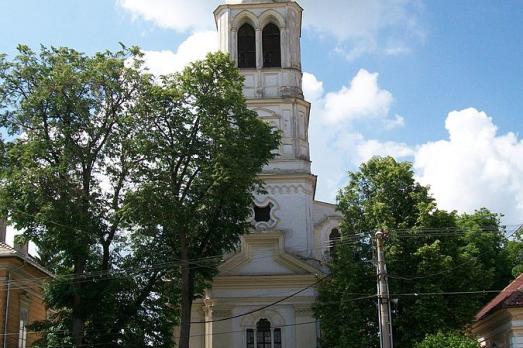
Rimavská Sobota, SK
The Evangelical Church of Rimavská Sobota was founded in 1786, and at that time it was located outside the city walls. As the evangelical population of the town was small compared to the Calvinists, they again turned to Emperor Joseph II (1765-1790) and asked him to collect donations from outside the state, which they obtained from the Swedish King Gustav III (1746-1792).
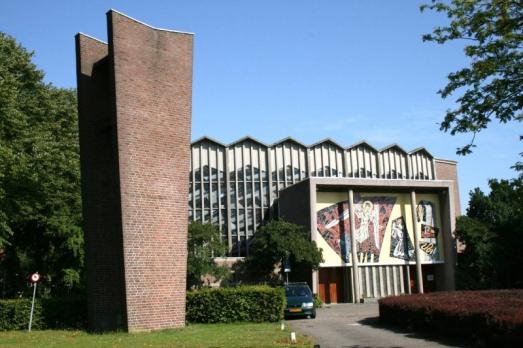
Amersfoort, NL
Architecturally very important, beautiful reconstruction church, with freestanding bell tower, and many interesting details. Highlight in the oeuvre of the architect Herman J. van Wissen (1910-2000). The trapezoidal floor plan was innovative in post-war Catholic church construction in our country.
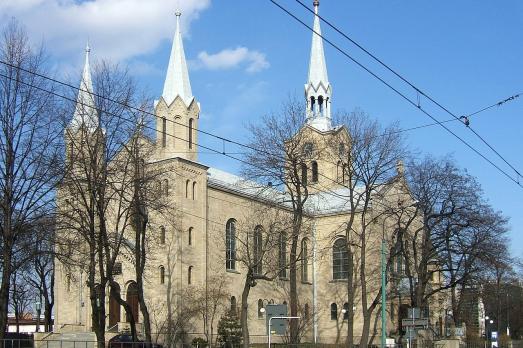
Katowice, PL
The Evangelical Church of the Resurrection was built from 1856 to 1858. The church was designed by the Berlin architect Richard Lucae and built in the neo-Romanesque style in a variant of the "Rundbogenstil". The rather small church was enlarged in the years 1887-1889 and 1899-1902. After the Second World War, between 1945 and 1947, the church was taken over by the Roman Catholic Church.
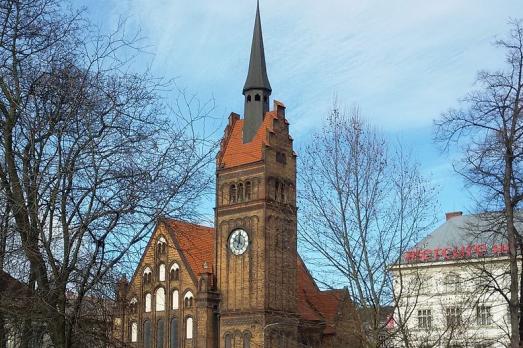
Ostrava, CZ
The Evangelical Church of Christ, or "red church", was built in 1905-1907 in the style of the Dutch Renaissance. Like many Protestant churches in Central Europe, it was once owned by German Protestants until the Second World War.
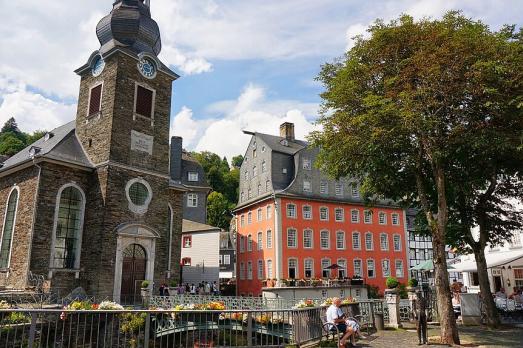
Monschau, DE
The Evangelical City Church of Monschau (Evangelische Stadtkirche) is an 18th-century building standing in the centre of the village.
Hoorn, NL
The Lutheran community in Hoorn actually dates back to 1628. Johannes Vyand(t), a German minister who had fled, held the first meeting for the Lutheran inhabitants of the city on 1 October of that year in the bakery of a certain Gerbrand on the Hanekamsteeg. A number of times after that, a space in the Munt was also rented for this purpose. On 15 October of the same year, the community was officially founded. From that time on, a building called 'De Roosenobel' was rented near the Noorderkerk. Soon, problems arose between the minister and the elders, which led to dismissal. Vyand(t), however, continued to preach on his own initiative, and this degenerated into a schism within the young community. The newly appointed minister soon also came into conflict with the church council. In 1632, a piece of land on the Tempelsteeg was purchased for fl. 1700, and construction of a church began. When the number of members increased, this church space was expanded with galleries in 1645. Halfway through the next century, there was an urgent need for a new church building, as the old church had become very dilapidated and the number of parishioners was increasing. Insoluble conflicts between the then minister and a number of church council members and the inability to secure the finances delayed the construction of the new church for years. During the term of office of Isaac Scholten (1766-1778), the plans for the new building were however revived. Various plans had been submitted regarding the architecture. Ultimately, the design by Jacob Hart dating from 1761 was chosen. The work was accepted on 1 April 1768 for fl. 20,300. The old church was demolished. On 2 July 1769, the new church at the Ramen could be consecrated. The three-aisled hall church with galleries above the side aisles is built of brick, while sandstone was used for the entrance and the frame of the central window above the entrance. On both sides of the facade are brick block pilasters. From these points the walls recede in a concave manner, while the central section projects forward. In this central risalit is the natural stone entrance with rococo crowning in which the inscription: "how lovely / are / Your dwellings, LORD Zebaoth! Psalm 84:2". The wooden barrel vault is decorated internally with carved rocailles in two shades of blue, with rosettes inside. Restorations of the church took place successively in 1825, in 1850, in the years 1922-1923, 1962-1964 and finally in the period 1994-1995. In the 1922-1923, due to the decline in the number of parishioners, the church space on the east side was shortened and the freed-up space was used for a new consistory room and meeting room. The rectory dating from 1773 was also sold at that time, as was the sexton's house with a swan in the fanlight of the front door, which was built at the same time as the church.
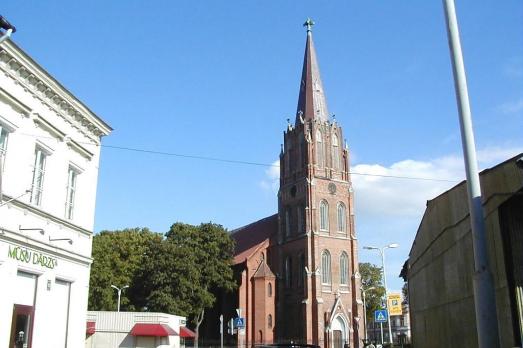
Liepāja, LV
The Evangelical Lutheran Church of St. Anne is the oldest church in Liepaja. The building dates back to 1587 and the tower was built between 1688 and 1693. The building and the towers were rebuilt in the second half of the 19th century. The church organ, built in 1913, is the third largest in Latvia.
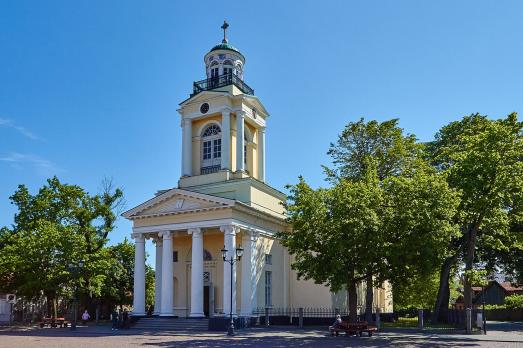
Ventspils, LV
The Evangelical Lutheran Church of St. Nicholas is named after Nicholas I following a donation from the Emperor to build the church between 1834 and 1835. The church remained intact during the two World Wars, but was restored at the beginning of the 21st century.
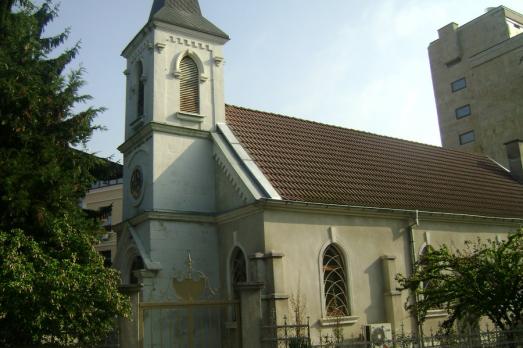
Shumen, BG
The Evangelical Methodist Church in Shumen is a testimony to the arrival of the first Methodist missionaries in Bulgaria in 1857. After the fall of communism, only three churches survived, one of which is located near Oborishte Square.

new
For a long time, Europe was ruled by powerful monarchies. Monarchy and religion have been connected since time immemorial. Here are 7 sites across Europe where royalty historically bent the knee to a higher power and received their crown.

Stupas are symbols of enlightenment and peace that commemorate different stages of Buddha's life. Since the mid-20th century, thousands of stupas have begun to populate Europe. We have compiled some of the most impressive ones in this list.

Walter Maria Förderer (1928–2006) was a Swiss architect and sculptor renowned for his neo-expressionist church designs in the 1960s. In this list we have compiled 6 of his church designs that seamlessly integrate religious and secular elements.

How is Religiana helping to conserve and promote Religious Heritage in Europe and why should you get involved?
Find out about Religiana
Are you a tourism organisation or religious heritage sites manager? Discover the advantages of becoming a partner.
See current partners
We can keep you up to date with the latest news from Religiana and religious heritage conservation across Europe.
Sign up to the FRH newsletter