Explore Religious Heritage Across Europe

Here you can search for a building to visit. You can use the map find destinations, or you can use the filters to search for a building based upon what different criteria.

Refine search

Evangelisch Lutherse Kerk

Groningen, NL

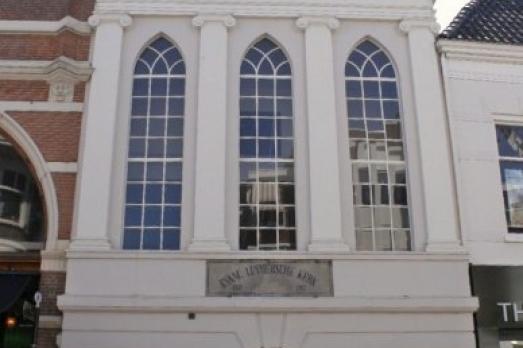
Evangelical Lutheran church building from 1696. In eclectic style built frontage with risalit from 1874, with risalit in which a relief in the shape of a swan, for the late 17th century (1696) hall church with gallery on three sides. The church has a richly carved pulpit 1696 with rear bulkhead and sounding board. Organ by Van Oeckelen, made in 1896.

Evangelisch Lutherse Kerk

Breda, NL

Important "hidden church" without a tower. The Reformation began in 1517 with the nailing of Luther's theses to the door of the castle church of Wittenberg, but it was not until around 1566 that a Lutheran community was established in Breda. The community consisted largely of people of German descent. For a long time, they had a hidden church on the Nieuwstraat. In 1777, the community bought a house on the Veemarktstraat, called 'Repos Ailleurs'. It was a large house with a forecourt. In 1786, the Lutheran church was consecrated in the renovated mansion. Two houses had been built on the forecourt so that the house could only be reached through a gate from the Veemarktstraat. It is the only still functioning hidden church in Breda. In 1838, the church was thoroughly renovated. The pointed arch windows that are visible from the inner courtyard were also installed then. The church was restored in 1966-1967.

Evangelisch Lutherse Kerk

Culemborg, NL

Evangelical Lutheran Church. Situated on the corner of Goilberdingerstraat and Achterstraat, simple, brick hall church, rebuilt in 1839 on the site of the chapel of the St. Pietersgasthuis, which was rebuilt for the Lutherans in 1676, already mentioned in 1386. The building has a hipped roof with a hexagonal wooden dome tower at the front, has pointed arch windows and an entrance in a simple Empire frame. Inside, a pointed arch wooden barrel vault and a pulpit with lectern and baptismal fence from around 1840. To the left and right of the pulpit, gentlemen's pews with panels, which show sculpture from 1676-1677. Organ with main work and secondary work, made in 1897 by G. van Druten. Bell frame with bell by G. Schimmel, 1686, diam. 48.8 cm.

Evangelisch Lutherse Kerk

Delft, NL

Former chapel St.Joris Gasthuis (15th century). From 1996 to 2003 the Evangelical Church "Het Levend Water" used this church. This Evangelical Church "Het Levend Water" has used (had used) two other locations since then.

Evangelisch Lutherse Kerk

Dordrecht, NL

Originally this was a chapel of the Blindeliedengasthuis, which was demolished in 1629. The Lutheran Community, founded in Dordrecht in 1618, was offered the church building by the community in 1689. The simple, late Gothic chapel had been used in the intervening years as a city coffin house and for storing peat. In the seventeenth century, the front and side facades of this national monument were provided with a layer of plaster, which was partly removed during the restoration of 1963. The Wolfferts organ from 1779, with parts from 1733, has two keyboards. The pulpit is in Louis XVI style.

Evangelisch Lutherse Kerk

Nijmegen, NL

Neo-Gothic building with turret. Out of use as Dutch Reformed Chapel in 1924, since then Evangelical Lutheran Church (ELK). This church is listed as a National Monument of the Netherlands. The church was put up for sale in 2021 despite protests.

Evangelisch Lutherse Kerk

Ede, NL

Beautiful, late small neo-Gothic church with roof turret and stained glass windows. Extended in 1937.

Evangelisch Lutherse Kerk

Haarlem, NL

Lutheran church, three-aisled building, which owes its current form to a major renovation around 1780 of an older building. Neo-Gothic facade with tower from 1895. Internally in the central nave a stucco barrel vault and galleries in the side aisles. Oak pulpit with oak baptismal fence from the second half of the 17th century. Organ made in 1882 by JA Strobel (Bad Frankenhausen) to replace the Bätz organ that was made in 1790. Two beautiful rococo singing boards with swans. Mid-17th century benches. Tribunes consistory (church council room) from 1910 with chimney piece and on wallpaper (linen stretched in wooden frames) the names of ministers, elders, church treasurers and deacons. Modern extension next to the church square.

Be inspired

Stupkalnis.lt

10 Buddhist stupas to discover in Europe

Stupas are symbols of enlightenment and peace that commemorate different stages of Buddha's life. Since the mid-20th century, thousands of stupas have begun to populate Europe. We have compiled some of the most impressive ones in this list.