Gereformeerde Kerk
Oldekerk, NL
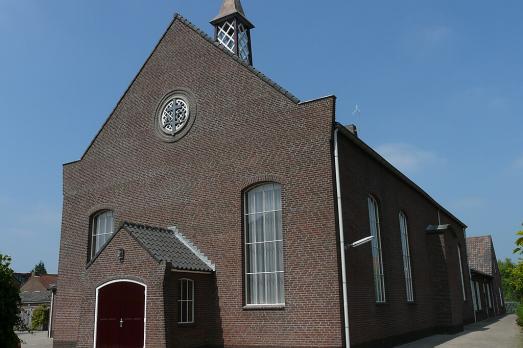
Reconstruction church with roof turret. Replaced an earlier church that was demolished in 1964.

Here you can search for a building to visit. You can use the map find destinations, or you can use the filters to search for a building based upon what different criteria.
Oldekerk, NL
Reconstruction church with roof turret. Replaced an earlier church that was demolished in 1964.
Sint Laurens, NL
Built as a Reformed Church. Hall church without tower in Amsterdam School style.
Renkum, NL
This reformed church on the Utrechtseweg in Renkum was put into use on 8 August 1928. The first stone had been laid the year before, on 2 December 1927. The building served as a replacement for a church from 1889 on the Molenweg. Design sketches date back to 1925 and were published as intended for a church in nearby Oosterbeek. It is likely that this is the same church. These sketches were much more daring and are much more in line with the expressive Amsterdam School than the final result. Due to war damage, the building is no longer original in all places and some additions have been made to the rear.
Den Bommel, NL
Hall church in neo-Romanesque style. Restored and renovated in 1955. A roof turret and (behind the church) a consistory were added at that time.
Almkerk, NL
In 1836, 411 members left the Reformed Church of Almkerk and Emmikhoven to found their own church community. The meetings took place in houses and barns. Under the name Christian Separated Church of Almkerk and Emmikhoven, the church community was recognized on November 28, 1840. The meeting place, the barn of Branderhorst on the Kil, was replaced by the barn of Jan den Dekker, at the top of the sidewalk of the Straatweg in Nieuwendijk. In the year 1860, the church barn made way for a church building on approximately the same location.
Daarle, NL
Hall church with roof turret. Beautiful interior with important organ.
Opeinde, NL
Modern church without tower. It replaced a church demolished in 1978. Reformed Church of Nijega, Opeinde and De Tike. The organ was built in 1989 by the firm Sicco Steendam (Warffum). Pipework from the previous organ of this church, which was delivered in 1913 by the firm L. van Dam & Zonen in Leeuwarden, was used for this.
Schoonrewoerd, NL
Neo-Romanesque hall church without tower. The church and rectory have been designated as iconic buildings by the municipality of Leerdam. Three renovations have taken place, including a major expansion of the church hall in 2008.
Elim, NL
Modern church with tower. Built to replace the wooden church destroyed by fire in 1962 .
Fijnaart, NL
This church building is now called (probably since about 2004, formation PKN) Ontmoetingskerk. Hall church without tower.

new
For a long time, Europe was ruled by powerful monarchies. Monarchy and religion have been connected since time immemorial. Here are 7 sites across Europe where royalty historically bent the knee to a higher power and received their crown.

Stupas are symbols of enlightenment and peace that commemorate different stages of Buddha's life. Since the mid-20th century, thousands of stupas have begun to populate Europe. We have compiled some of the most impressive ones in this list.

Walter Maria Förderer (1928–2006) was a Swiss architect and sculptor renowned for his neo-expressionist church designs in the 1960s. In this list we have compiled 6 of his church designs that seamlessly integrate religious and secular elements.

How is Religiana helping to conserve and promote Religious Heritage in Europe and why should you get involved?
Find out about Religiana
Are you a tourism organisation or religious heritage sites manager? Discover the advantages of becoming a partner.
See current partners
We can keep you up to date with the latest news from Religiana and religious heritage conservation across Europe.
Sign up to the FRH newsletter