Heilige Johannes' Onthoofding
Loon op Zand, NL
Historic village church with high tower. Restoration and extension in 1929 to a design by HW Valk.

Here you can search for a building to visit. You can use the map find destinations, or you can use the filters to search for a building based upon what different criteria.
Loon op Zand, NL
Historic village church with high tower. Restoration and extension in 1929 to a design by HW Valk.
Eindhoven, NL
Until 1796 a reformed (also called: reformed) church, then Roman Catholic, demolished in 1885. In 1884 the foundation stone was laid for the current Roman Catholic St. Joriskerk. Hendrik van Tulder from Tilburg drew the design. The church was put into use in 1885. A tower with side chapels was added in 1910 to a design by Jac. van Gils. Restoration started in 2003.
Haarlem, NL
Exceptionally important neoclassical church. Main work of architect HH Dansdorp. Roman Catholic Church of St. Joseph, consecrated 1843. From 1853 to 1898 cathedral of the re-established Diocese of Haarlem. Extended for this purpose in 1856. Large neoclassical church with turret on the front facade. Architect: HH Dansdorp; three-aisled neoclassical church, provided with a barrel vault over the central nave. Façade of natural stone; high round columns carry tympanum, round dome tower on Corinthian columns. Largely late nineteenth-century decoration and inventory.
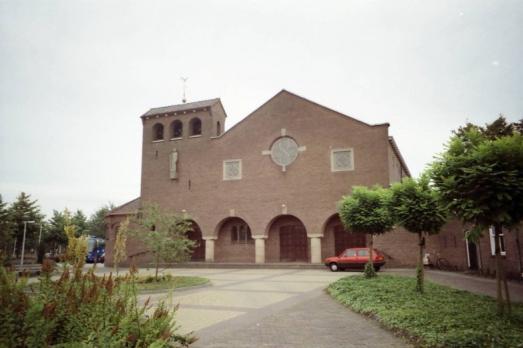
Almelo, NL
Heilige Jozef is a Roman Catholic church built in 1953 in Almelo. It was built in the style of the Delft School.
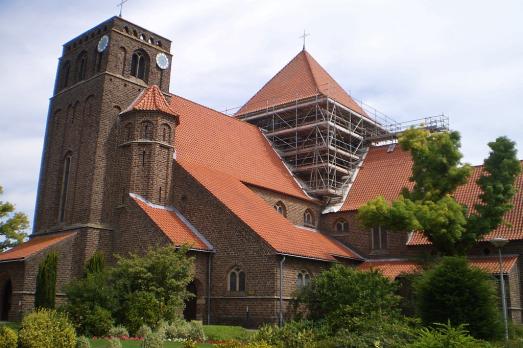
Achterveld, NL
Heilige Jozef (Church of St Joseph) was built in 1933. It was designed by Hendrik W. Valk (1886-1973). It is listed as a National Monument of the Netherlands.
Siebengewald, NL
Destroyed by war in 1944.
Leusden, NL
The neo-Gothic CHAPEL on the Roman Catholic cemetery behind the Roman Catholic church St. Joseph on the Hamersveldseweg was built in 1916 to a design by the architect H. Kroes. The chapel is situated at the end of the main axis in the south-eastern corner of the cemetery. The chapel has a floor plan in the shape of a Greek cross and has a basement. The roof, covered with slates in Maasdekking, consists of two intersecting saddle roofs with a roof turret at the intersection. A zinc finial has been placed on the four ridge ends. The facades are built of gray brick in cross bond. The four gables are flanked by a cut buttress that ends in a pinnacle. The pinnacles are provided with a crowning with a chevron-shaped ornament similar to that on the entrance gate to the cemetery. The front (west side) contains a large pointed arch opening with a frame in red brick. Above the opening is a medallion with a representation of the resurrection of Christ. Around the medallion and along the roof edge is a band of decorative brickwork in red brick. A partly natural stone pavement leads to the opening, closed off by a two-winged, rotating iron bar gate with a narrow, fixed fence on either side. The connecting posts of the gate are crowned with ornaments in Art Nouveau style. The central post is provided with a cross.
Delfzijl, NL
Roman Catholic parish church of St. Joseph from 1925. Replaced a smaller, nearby church from 1819, which stood at the current Johan van der Kornputplein. Crucifix basilica on a somewhat centralised plan with a wide central nave, narrow side aisles and a front tower with a spire. Sober, characteristic work in the oeuvre of the Oldenzaal architect Clemens Hardeman in the late neo-Gothic style.
Melissant, NL
The St. Joseph Chapel in Melissant was put into use on 14 November 1900. Until then, the Roman Catholics of the village had to rely on the parish church in Middelharnis. The construction of the chapel and residence was financed by the diocese of Haarlem, under which the South Holland islands belonged at the time, from a legacy received from the estate of Baron RHI van Brienen and from several creations. This church is listed as a National Monument of the Netherlands.
Beringe, NL
On the site of the former Roman Catholic Chapel of Our Lady of the Sacred Heart . Damaged by war in 1944. Restored.

new
For a long time, Europe was ruled by powerful monarchies. Monarchy and religion have been connected since time immemorial. Here are 7 sites across Europe where royalty historically bent the knee to a higher power and received their crown.

Stupas are symbols of enlightenment and peace that commemorate different stages of Buddha's life. Since the mid-20th century, thousands of stupas have begun to populate Europe. We have compiled some of the most impressive ones in this list.

Walter Maria Förderer (1928–2006) was a Swiss architect and sculptor renowned for his neo-expressionist church designs in the 1960s. In this list we have compiled 6 of his church designs that seamlessly integrate religious and secular elements.

How is Religiana helping to conserve and promote Religious Heritage in Europe and why should you get involved?
Find out about Religiana
Are you a tourism organisation or religious heritage sites manager? Discover the advantages of becoming a partner.
See current partners
We can keep you up to date with the latest news from Religiana and religious heritage conservation across Europe.
Sign up to the FRH newsletter