Heilige Victor
Benschop, NL
Neo-Gothic church with tower. Replaced an older church from 1810. To the left of the oriented church is a monumental parsonage.

Here you can search for a building to visit. You can use the map find destinations, or you can use the filters to search for a building based upon what different criteria.
Benschop, NL
Neo-Gothic church with tower. Replaced an older church from 1810. To the left of the oriented church is a monumental parsonage.
Obdam, NL
The foundation stone for the current St. Victor Church in Obdam was laid on 21 April 1891 by construction pastor Fit. Fifteen months later – on 25 July 1892 – the church was consecrated by the then bishop of Haarlem Mgr.CJM Bottemanne. The church is a cruciform basilica in neo-Gothic style. The architect of the St. Victor Church was Adrianus Cyrianus Bleys, who came from Hoorn. He designed and built many churches and buildings in North Holland, including the old Dionysius Church in Heerhugowaard, the Cunera Church in Nibbixwoud, the Koepel Church in Hoorn and the St. Nicolaas Church in Amsterdam. The Mill Hill building and the town hall of Obdam were also designed by him. The predecessor of the current church, which was also dedicated to St. Victor, stood on the other side of the road, where Victor's Hof is now located. The robust marble baptismal font on the right at the back of the church was moved from the old church, as were the two bells. The bells were stolen during the war. One of the bells was spared. The other was replaced by a new one. The beautiful Stations of the Cross are striking in the church. They are made in 'haute relief' and come from the studio of E. van Ternelmont from Den Bosch. The stations were installed in 1910. The chandeliers above the central aisle are also beautiful. There are seven paintings in the apse of the Priest's Choir. Five of the seven scenes depict events from the Old Testament, which can be considered prefigurations of the Eucharist. Seen from the church, we see from left to right: (1) the sacrifice of Abel; (2) the priest-king Melchisedec offers bread and wine as a meal of thanksgiving; (3) Abraham is about to sacrifice his only son Isaac; (4) the Jewish people gather manna in the desert; (5) the prophet Elijah is strengthened by an angel. At the front of the church we see a statue of our patron saint St. Victor. He was a Roman soldier who refused to participate in a pagan sacrificial ceremony because of his Christian faith. He was then killed by his comrades and thus died a martyr's death. St. Victor is an example to us because of his steadfastness in faith. St. John Nepomuk was also steadfast. His statue is located at the front of the confessional. He is the patron saint of the secret of confession. Devotion to Mary is expressed in two places in the church. At the front of the church we see a reduced copy of the famous icon of Mary of Perpetual Help. The statue of Mary that used to be here has been given a place at the back of the church. In 2006, a new chapel in honour of Mary of Lourdes was built behind the rectory. The reason was the parish pilgrimage to Lourdes the year before.
Neerloon, NL
The church is designed as a single-nave church with a saddle roof. The 14th-century tower has tufa in the lower layers and was raised around 1820. During this raising, the existing sound holes were bricked up and new sound holes were made with round arches. The clock from 1929 was made by the clock manufacturer Eijsbouts from Asten, who also started making clocks after the Second World War. The tower has a tent roof. The church has an organ, made in 1845 by Franciscus Cornelius Smits. In addition, there is a lowered altar from around 1700. The church was designated a national monument in 1965. This church is listed as a National Monument of the Netherlands.
Amsterdam, NL
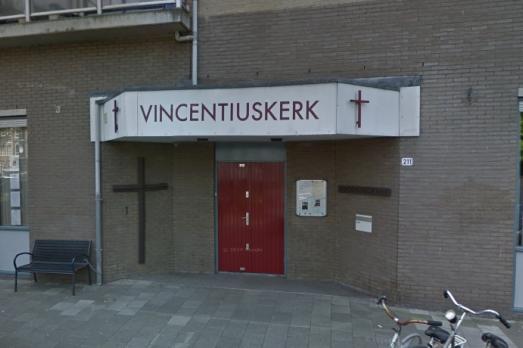
The church was built on the south bank of the Jacob van Lennepkanaal . It was consecrated on 7 October 1901.The large three-aisled basilica had a high tower to the right of the front facade. This tower had an octagonal superstructure with corner pinnacles and a spire. This 67-metre-high tower in particular (the highest tower in Roman Catholic Amsterdam) was a striking appearance, because the surrounding houses were no higher than four floors.
Deursen, NL
Roman Catholic Church of St. Vincentius, single-nave neo-Gothic church with narrower three-sided closed choir and west tower with four-sided spire. (Church 1874 by C. van Dijk, spire 1919 by F. de Beer). In the church tower two bells, one cast in 1589 and one in 1662 by Henricus Wegewaert in Enkhuizen. Between main and side entrance statue of Mary with inscription "mother". Churchyard with prayer house and plaster, polychrome crucifix. Mortuary under saddle roof. Five priests' graves from 1862, 1901, 1915, 1918. (Deursen), spire 1919.
Brunssum, NL
Roman Catholic Church Parish of St. Vincentius a Paulo in Brunssum.
Hilversum, NL
Important, unique monumental neo-baroque church with dome. Replaced a nearby clandestine church. Restored after a fire in 1958. The interior has its current appearance since then.
Hilversum, NL
Neo-Gothic church with cathedral allure, and with a high tower. The Sint-Vitus was consecrated in 1892. This neo-Gothic cruciform basilica was designed by PJH Cuypers. The tower is 98 metres high and is one of the 4 highest church towers in the Netherlands *. The church stands on the site of the former clandestine church from 1786. Important elements in the interior are the wooden vault, the stained glass windows and the colourful brick patterns in the masonry. The Van den Brink organ from 1859 and the painted Stations of the Cross are also valuable.
Dedemsvaart, NL
Replaced a church from 1819. Three-aisled neo-Gothic hall church with a sober square west tower, crowned by a constricted spire. Characteristic early work from the oeuvre of WVA Tepe (1840-1920). The side aisle bays are provided with hipped roofs, which betrays the influence of the late Lower Rhine and Westphalian Gothic. In 1929 the church was extended with a new transept and choir, designed by HCM van Beers.
Blaricum, NL
Historic village church with tower. Extension with consistory behind the choir during restoration in 1934-1935.

new
For a long time, Europe was ruled by powerful monarchies. Monarchy and religion have been connected since time immemorial. Here are 7 sites across Europe where royalty historically bent the knee to a higher power and received their crown.

Stupas are symbols of enlightenment and peace that commemorate different stages of Buddha's life. Since the mid-20th century, thousands of stupas have begun to populate Europe. We have compiled some of the most impressive ones in this list.

Walter Maria Förderer (1928–2006) was a Swiss architect and sculptor renowned for his neo-expressionist church designs in the 1960s. In this list we have compiled 6 of his church designs that seamlessly integrate religious and secular elements.

How is Religiana helping to conserve and promote Religious Heritage in Europe and why should you get involved?
Find out about Religiana
Are you a tourism organisation or religious heritage sites manager? Discover the advantages of becoming a partner.
See current partners
We can keep you up to date with the latest news from Religiana and religious heritage conservation across Europe.
Sign up to the FRH newsletter