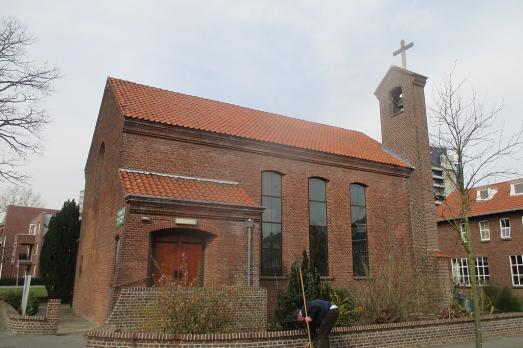
Heilige Willibrordus
Arnhem, NL
The church building dates from 1941, which was of course a strange time to build a church. On the other hand, it was not yet known at that time whether the German occupation would be permanent.

Here you can search for a building to visit. You can use the map find destinations, or you can use the filters to search for a building based upon what different criteria.
Arnhem, NL
The church building dates from 1941, which was of course a strange time to build a church. On the other hand, it was not yet known at that time whether the German occupation would be permanent.
Oldemarkt, NL
Early churches: The first church, the 15th-century Nicolaaskerk , still exists, but has been in Protestant hands since the Reformation. In the 17th and 18th centuries, masses were celebrated in houses and farms in the area. In 1804, the Catholics of Oldemarkt submitted a request to be allowed to build a church in the village, but it was not until 1828-1829 that this plan could be realised. This church, which stood on the site of the current one, was initially dedicated to St. Nicholas (according to Van der Aa in 1846) and only later in the 19th century to St. Willibrord. After it separated from Steggerda and Steenwijkerwold, Oldemarkt became an independent station in 1825 (according to Voets; Leeuwenberg mentions a deed of foundation from 1850). This church is listed as a National Monument of the Netherlands.
Bodegraven, NL
The Sint-Willibrorduskerk in Bodegraven was designed around 1859 by Pierre Cuypers (1827 - 1921). It was consecrated in 1865. The building is a three-aisled cruciform basilica in brick, in a sober early Gothic style with pointed wooden barrel vaults. The nave is four bays deep and has a cross-shaped building that connects to the choir. The choir is one bay deep and is connected to rectangular radiating chapels. It is closed on five sides and is covered by brick vaults. The brickwork is made of grey-red brick and has braids and bands of yellow and black stone in the interior. The church was consecrated on 10 July 1865 by Mgr. Wilmer.
Middelbeers, NL
This church is listed as a National Monument of the Netherlands.
Demen, NL
Built by Pierre Cuypers (1827 - 1921) while retaining the 15th century tower of the former church, in 1890 this architect clad it, raised it and provided it with a staircase tower. The church consists of a nave of five bays, covered by a pointed wooden barrel vault and a choir with 5/8 closure and brick cross-ribbed vaults. Tower 15th century.
Berghem, NL
Tower added in 1475. Church demolished in 1856, and replaced. The historic tower was then maintained.
Klein Zundert, NL
Originally, Klein Zundert had a medieval church. This building was restored somewhat around 1610, after severe damage in the Eighty Years' War, and made usable, and partly provided with a new interior. In 1645, further renovation and restoration followed, during which armorial glasses were also installed, made by the 'glass writer' Jean de la Habarre. Again, new altars were installed, including two side altars with lecterns, by Alph. Jordaens, and a pulpit by Hendrik van Velmen, modelled on the one in Minderhout.
Sappemeer, NL
St. Willibrordus, 1866-1873, Pierre Cuypers (1827 - 1921) . Three-aisled neo-Gothic hall church without transept. Pointed gables on the side aisle bays. Tower with two niches in each facade, frontals and four-sided spire. Articulated brick pillars with moulded capitals, cross-ribbed vaults. Polychrome interior with painted brick; furnishings and glazing from the construction period, from the Cuypers & Stolzenberg studio in Roermond. The windows in the nave partly come from the St. Martinus church in Foxham-Martenshoek, which closed in 1990. Early work from Cuypers' second period, influenced by the Westphalian hall church Gothic. Mechanical tower clock.
Bergschenhoek, NL
Charming neo-Romanesque church with tower designed by AAJ Margry, built to replace a church from 1833.
Neerkant, NL
Hall church on an almost rectangular plan, consisting of a partly exposed concrete skeleton, filled with brick. A detached, openwork bell tower and semi-detached baptismal chapel to the side. Front facade with simple narthex. The central nave is covered by a curved concrete shell roof. As a whole, the church is an important example of renewal, also a fairly exceptional early example of modernism in Roman Catholic church architecture from the 1950s. This church is listed as a Municipal Monument of the Netherlands.

new
For a long time, Europe was ruled by powerful monarchies. Monarchy and religion have been connected since time immemorial. Here are 7 sites across Europe where royalty historically bent the knee to a higher power and received their crown.

Stupas are symbols of enlightenment and peace that commemorate different stages of Buddha's life. Since the mid-20th century, thousands of stupas have begun to populate Europe. We have compiled some of the most impressive ones in this list.

Walter Maria Förderer (1928–2006) was a Swiss architect and sculptor renowned for his neo-expressionist church designs in the 1960s. In this list we have compiled 6 of his church designs that seamlessly integrate religious and secular elements.

How is Religiana helping to conserve and promote Religious Heritage in Europe and why should you get involved?
Find out about Religiana
Are you a tourism organisation or religious heritage sites manager? Discover the advantages of becoming a partner.
See current partners
We can keep you up to date with the latest news from Religiana and religious heritage conservation across Europe.
Sign up to the FRH newsletter