Heilige Willibrordus
Milheeze, NL
This church is listed as a National Monument of the Netherlands.

Here you can search for a building to visit. You can use the map find destinations, or you can use the filters to search for a building based upon what different criteria.
Milheeze, NL
This church is listed as a National Monument of the Netherlands.
Riethoven, NL
Roman Catholic Church of St. Willibrord. Since the renovation and extension by architect C. Franssen in 1890-99, only some masonry remains of the 15th century church, namely the 3/8 closed choir, the transept and the substructure of the tower. Bell frame with two bells by W. Kaerwas, 1478, diam. 116 and 102 cm respectively. Mechanical tower clock, Van Dorst (Gilze), 1896, electrically wound.
Oegstgeest, NL
Iconic neo-Gothic church with a tower placed sideways, next to the choir. Around 1900, the church from 1772 became too small and it was decided to build a new church and parsonage. The architectural firm Cuypers/Stuyt was commissioned to do this. Father Cuypers was the builder of the Central Station and the Rijksmuseum in Amsterdam. Son Cuypers built the new St. Bavo Cathedral in Haarlem. The Holy Willibrord Church was therefore not built by just anyone. The church is a fine example of neo-Gothic church architecture from that period.
Ruurlo, NL
During the Reformation, the Catholics of Ruurlo attended church in Zwillbrock, just across the German border. From 1801, they had a barn church in their own municipality. In 1828, a new, larger church was completed. In its place, the current parish church, dedicated to St. Willibrordus, was built in 1869-1870, based on a design by Dr. Pierre Cuypers (1827 - 1921). The church, like that of Cuypers in neighbouring Kranenburg, was built thanks to a legacy from Baron Van Dorth tot Medler. The church was originally built as a single-nave hall church with a narrowed and straight-closed choir, side-mounted gables, and a front tower. The interior is covered by a wooden barrel vault.
Berkel (NB), NL
A church was already mentioned in Berkel in 1214. It is known that the building was renovated in 1440. In 1983, large foundations of that church were exposed in, among other places, the garage of the rectory.
Oeffelt, NL
This church is listed as a National Monument of the Netherlands.
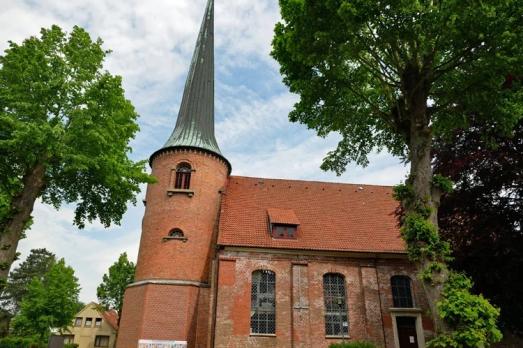
Barmstedt, DE
Heiligen-Geist-Kirche is located in Barmstedt, a town in Schleswig-Holstein about 20 miles north-west of Hamburg.
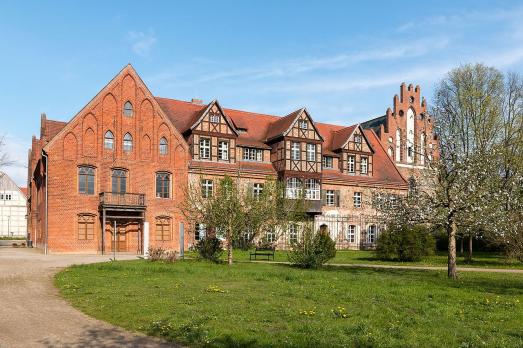
Heiligengrabe, DE
Heiligengrabe Abbey is a former Cistercian abbey which was founded at the end of the 13th century. The first buildings to be constructed were the abbey church and the eastern wing of the cloister; the latter contains the chapter house on the ground floor and the sisters' dormitory on the ground floor. The other two wings are from slightly later periods. In 1510, the cloister was vaulted; the chapter house was moved to the west wing. When the Reformation was adopted, the monastery went through a period of conflict; finally, in 1549, the entire community was transferred to the Lutheran church.
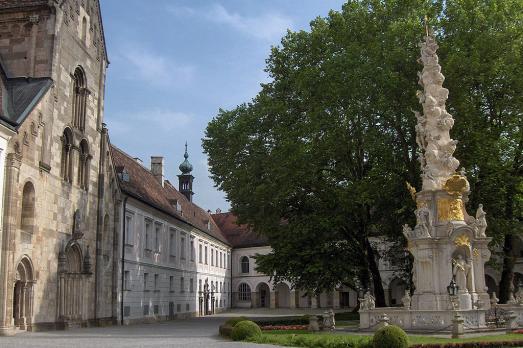
Heiligenkreuz im Wienerwald, AT
Heiligenkreuz Abbey (Stift Heiligenkreuz) is a Cistercian monastery in the village of Heiligenkreuz in the southern part of the Vienna Woods. Founded in 1133, it is the oldest continuously occupied Cistercian monastery in the world. With more than 270,000 volumes, the monastery library is the largest private library in Austria. At the heart of the library is the medieval collection of 1250 manuscripts and 860 incunabula. Today, the monastery library is an institution of knowledge and a partner of various regional and even international research centres.
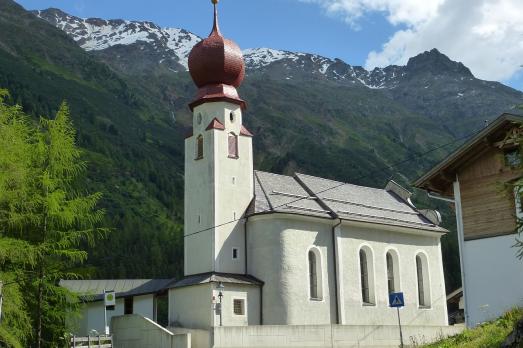
Soelden, AT
The Heiligkreuz church was built in 1804 and restored in 1976. The tower stands at the head of the choir and has flat arched windows and an octagonal transition to the onion dome. The gabled façade has a scrolled gable above a continuous main cornice. The three-bay nave is followed by a slightly indented basket-arched choir. Ludwig Sturm painted the vault in 1936.

new
For a long time, Europe was ruled by powerful monarchies. Monarchy and religion have been connected since time immemorial. Here are 7 sites across Europe where royalty historically bent the knee to a higher power and received their crown.

Stupas are symbols of enlightenment and peace that commemorate different stages of Buddha's life. Since the mid-20th century, thousands of stupas have begun to populate Europe. We have compiled some of the most impressive ones in this list.

Walter Maria Förderer (1928–2006) was a Swiss architect and sculptor renowned for his neo-expressionist church designs in the 1960s. In this list we have compiled 6 of his church designs that seamlessly integrate religious and secular elements.

How is Religiana helping to conserve and promote Religious Heritage in Europe and why should you get involved?
Find out about Religiana
Are you a tourism organisation or religious heritage sites manager? Discover the advantages of becoming a partner.
See current partners
We can keep you up to date with the latest news from Religiana and religious heritage conservation across Europe.
Sign up to the FRH newsletter