Heilige Servatius
Lieshout, NL
Church building from 1962, surrounded by the former moat of Ribbius House, of which a historic gate has been preserved.

Here you can search for a building to visit. You can use the map find destinations, or you can use the filters to search for a building based upon what different criteria.
Lieshout, NL
Church building from 1962, surrounded by the former moat of Ribbius House, of which a historic gate has been preserved.
Erp, NL
Roman Catholic church of St. Servatius. Church building in Waterstaat style (baroque classicism) from 1843-1844 by A. van Veggel. Square domed tower on the west facade. Internal Corinthian columns on high basements and with imposts; rib vaults over the hall space. Inventory: high altar and statues in the choir from the studio of PJH Cuypers, 1896. Pulpit from 1858 by the carpenter J. Buijssen from Boxmeer and the Antwerp sculptor JB Peeters. Confessionals decorated with statues by H. van der Mark and H. Meyers from 1856. Against the side aisle walls statues of Ambrosius, Servatius, Anna and Barbara from 1850, by JB Peeters. Organ case by H. Meyers, the balustrade and its statues (David and Caecilia) by H. Van der Mark, woodcarver from Oirschot. In the organ case an instrument with main work, positive and free pedal, made in 1848 and 1858 by JJ Vollebregt and Son. Furthermore statues of Antonius Abt and Catharina by JB Peeters. Bell frame with chime consisting of a bell by anonymous founder, 1412, diam. 95 cm. and a bell by an anonymous founder, 1381, diam. 110 cm and a modern bell.
Amsterdam, NL
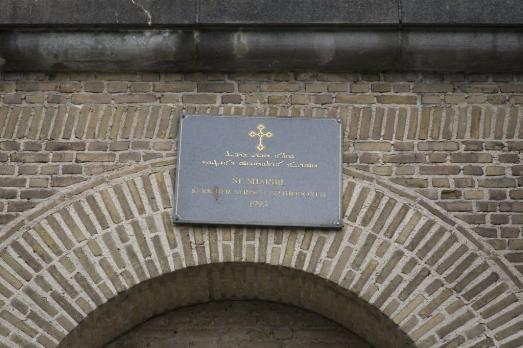
Important reconstruction church. Three-aisled basilica church on a rectangular plan, built under the influence of the Bossche School. Stylistically strongly influenced by Roman and early Christian architecture. The tower was not built. As a Roman Catholic Church out of use in 1993, now the Syrian Orthodox Church of St. Sharbil.
Hasselt, NL
The place where the current church stands is special and has traditionally been called 'the Holy City'. If you look at the aerial photo (Google), you will see an interrupted segment of a circle in the shadow of the church. This segment of a circle lies as an elevation against the north side of this church. This segment appears to be part of the hill on which the medieval church stood.
Dieteren, NL
Neo-Romanesque church with large tower placed on the side. Characteristic Boosten church. The medieval chapel (later church) of Dieteren was first mentioned at the beginning of the 16th century. It stood at the cemetery, on the current northern exit road, towards Echt. This church was demolished at the beginning of the forties of the 1800s. In 1835, Dieteren was separated from the mother parish of Susteren and elevated to an independent parish. That is why a new, larger church was built on the same site around 1845, in a transitional style between classicism and neo-Gothic. Due to its dilapidated state, a new neo-Romanesque church was built in the centre of the village from 1938 to 1940, designed by architect Alphons Boosten from Maastricht. The main entrance is on Kerkstraat and the nave is separated from Vleutstraat by a narrow garden, which is used as a fairground on public holidays. In 1940 the new church was consecrated by the bishop, after which the church from 1845 was demolished.
Borne, NL
St. Stephanus. Iconic, non-oriented church, 1887-1888 by N. Molenaar. Three-aisled neo-Gothic HALL CHURCH with transept and five-sided closed choir, based on Westphalian Gothic. The high tower was added in 1894. Window triplets in the end gables of the transept and in the west gable. Tower to the left of the front gable on the first side aisle bay. The church was extensively modernised internally in 1967, during which the original floors and parts of the inventory were lost; the polychromy was painted over. A new restoration followed in 1987-1988 under the direction of A. Meerstadt. The church interior is covered by cross-ribbed vaults. The inventory largely dates from the construction period. The statues come from the studios of FW Mengelberg and JP Maas. The main altar, the side altar, the triumphal cross and the pulpit were made by Te Poel & Stoltefus. The stained glass windows were made in the workshop of the firm Nicolas & Zoon. In the roof turret a clock by Petit and Fritsen, 1888, diam. 43.7 cm. Mechanical tower clock JF Weule Bockenem, 1894, out of use.
Stevensweert, NL
Cruciform building from 1781 with wooden west tower and a western extension from 1948. High altar, two side altars, two choir stalls, two confessionals and communion bench, 18th century. Baptismal font from around 1200. Marble holy water font, 18th century. Pulpit, 19th century. Organ and organ gallery, 19th century. 36 pews. 18th century. Stone statue of St. Stephen, 15th century. Wooden statues: Annatrits, 16th century, in a wooden niche, 17th century; Madonna, 17th century A, in a wooden niche; fragment of a group of angels, from around 1700; crucifix, 18th century A, of a Calvary; small corpus, 17th century A, of a wayside cross; bust on a pedestal of St. Ambrose, 18th century A; St. Peter and St. Paul, 19th century. Walled cemetery, including seven grave crosses, 1642-1762.
Bornerbroek, NL
Neo-Gothic hall church by G. te Riele, enlarged in 1920 in traditionalist style by architect Kropholler: Nave extended and new tower on the north side of the front, new chancel. Striking buttress on the outside, accentuates where in the interior the chancel is located. Parts of the original church are still recognizable as such in the exterior.
Hertme, NL
Neo-Gothic church with tower with constricted spire, designed by Wolter te Riele (1867 - 1937), consecrated in 1903. The raised fourth bay of the pseudo-basilica nave is treated as a transept without gables, the choir is closed on three sides. Internally plastered net vaults.
Geldermalsen, NL
Small reconstruction church with roof turret. Built as a Roman Catholic church.

new
For a long time, Europe was ruled by powerful monarchies. Monarchy and religion have been connected since time immemorial. Here are 7 sites across Europe where royalty historically bent the knee to a higher power and received their crown.

Stupas are symbols of enlightenment and peace that commemorate different stages of Buddha's life. Since the mid-20th century, thousands of stupas have begun to populate Europe. We have compiled some of the most impressive ones in this list.

Walter Maria Förderer (1928–2006) was a Swiss architect and sculptor renowned for his neo-expressionist church designs in the 1960s. In this list we have compiled 6 of his church designs that seamlessly integrate religious and secular elements.

How is Religiana helping to conserve and promote Religious Heritage in Europe and why should you get involved?
Find out about Religiana
Are you a tourism organisation or religious heritage sites manager? Discover the advantages of becoming a partner.
See current partners
We can keep you up to date with the latest news from Religiana and religious heritage conservation across Europe.
Sign up to the FRH newsletter