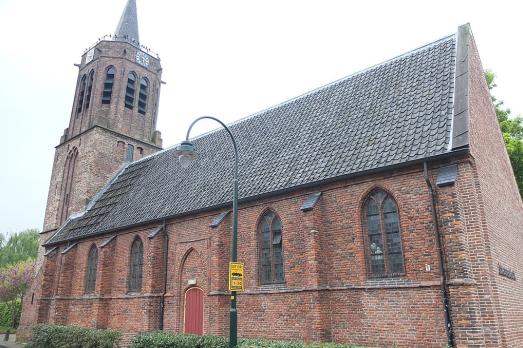
Johanneskerk
Amersfoort, NL
Important modern church with small bell tower in the centre of Amersfoort.

Here you can search for a building to visit. You can use the map find destinations, or you can use the filters to search for a building based upon what different criteria.
Amersfoort, NL
Important modern church with small bell tower in the centre of Amersfoort.
Soest, NL
Modern, inconspicuous church without tower. Out of use as a Roman Catholic church building 06-07-2008. After that, in 2009, it was put into use as a church of the PKN Reformed "local community of a special nature".
Nieuwerkerk, NL
Historic church with hexagonal tower rebuilt in 1975-1976. This church is listed as a National Monument of the Netherlands.
Rotterdam, NL
Built as Dutch Reformed Church in the Lombardijen district in Rotterdam-South. Modern church with tower. The church is also used on Saturdays as a church for the Adventist Church Rotterdam International (a Seventh-day Adventist church).
Gorinchem, NL
Built as a Reformed Church. Extremely important, large, beautiful reconstruction church with a large tower. From ± early 2000s this church was threatened with closure and demolition. In the late 2010s this church was designated as a Municipal monument.
Breda, NL
Dutch Reformed Church. Building in Water Board style from 1819 designed by N. Plomp. Plastered facade with semicircular Ionic pilasters, pediment and domed roof turret. Beautiful pavement posts with fence. Two memorial stones in the facade, in which the founding decree of King William I is commemorated. Beautiful oak pulpit and copper lectern in Louis XVI style from the 18th century from Katwijk aan Zee. Copper reader's luthier from approx. 1815. The Dutch Reformed Church of St. John in Princenhage put a new Van den Heuvel organ into use on 10 January 2004. It replaced an electronic organ that was installed behind a false front.
Heerde, NL
Reformed church, consisting of the late Gothic tower, and the choir, probably from the first half of the 15th century. The tall tower has three sections, a square ground plan, and is crowned by an octagonal constricted spire from 1907. The base is made of brick, the rest is made of tuff stone. In 1869, the tower was provided with a detailing of arched niches and friezes in neo-Romanesque style. Around the spire is a neo-Gothic balustrade. On the third section is a mechanical tower clock by LWF Volcke in The Hague, from the last quarter of the 19th century.
Leersum, NL
The church was designed by the architectural firm G. Steen en Tuinhof, Leeuwarden/Vlissingen. Construction began in 1966. The first stone was laid by Mr. JC Alberts, the oldest of the 328-member Reformed congregation. The church was put into use on 25 February 1967. The name Johanneskerk was chosen following a competition. In 1979, the church was expanded with an extension with a kitchen.
Opheusden, NL
Late Gothic village church with three-aisled, pseudo-basilica nave and transept, dated 1524. Single-aisled 15th century choir. Sacristy in the corner between choir and southern transept. After the war destruction in 1940, in which the tower and the western part of the nave were lost, the nave was extended to the west during the restoration (1949-'50). The church has four tombstones from the 17th and 18th centuries. This church is listed as a National Monument of the Netherlands.
Burgwerd, NL
The church of Burgwerd probably dates from the 13th century, and was originally built, it is assumed, in Romanesque Gothic style. In the years 1724-1726 the church was thoroughly renovated. The tower used to have a brick spire, and was given its current form in 1816. Large church building situated on a moated churchyard, Gothic in design, probably completely bricked up and provided with larger windows in the 17th century. Closed upright tower. Mechanical wrought iron tower clock, 17th century. Bell frame with clock by J. van Bremen, 1512, diam. 106.5 cm.

new
For a long time, Europe was ruled by powerful monarchies. Monarchy and religion have been connected since time immemorial. Here are 7 sites across Europe where royalty historically bent the knee to a higher power and received their crown.

Stupas are symbols of enlightenment and peace that commemorate different stages of Buddha's life. Since the mid-20th century, thousands of stupas have begun to populate Europe. We have compiled some of the most impressive ones in this list.

Walter Maria Förderer (1928–2006) was a Swiss architect and sculptor renowned for his neo-expressionist church designs in the 1960s. In this list we have compiled 6 of his church designs that seamlessly integrate religious and secular elements.

How is Religiana helping to conserve and promote Religious Heritage in Europe and why should you get involved?
Find out about Religiana
Are you a tourism organisation or religious heritage sites manager? Discover the advantages of becoming a partner.
See current partners
We can keep you up to date with the latest news from Religiana and religious heritage conservation across Europe.
Sign up to the FRH newsletter