Explore Religious Heritage Across Europe

Here you can search for a building to visit. You can use the map find destinations, or you can use the filters to search for a building based upon what different criteria.

Refine search

Maartenskerk

Ophemert, NL

The polygonal closed choir, decorated with natural stone blocks on the buttresses and with blocks in the window ledges, has been preserved from the late Gothic village church. The choir is covered by a net vault. The nave was renovated in 1858 and renovated again in 1955 in a style adapted to the Gothic choir. The inventory includes: a pulpit, 1662 and six 18th century funeral boards. Churchyard wall. Brick wall around the churchyard, 18th century? Two-manual organ, made in 1859 by CGF Witte. The original front was lost during a shelling of the tower in 1944-1945. In 1954, the firm JC Sanders & Zoon (Utrecht) made a new front with pinewood and hardboard. In 1988, the organ was restored by the firm HB Scheuerman & Zoon (Rotterdam). The original front was reconstructed after the example of the Witte organ from 1860 in the reformed church in Bunschoten. The case remains outside the protection. This church is listed as a National Monument of the Netherlands.

Maartenskerk

Hillegom, NL

Partly historic church with tower. Dutch Reformed Church. Originally Catholic St. Martin's Church.

Maartenskerk

Maartensdijk, NL

Reformed Church. Late Gothic church building, tower single-aisled nave with narrow transepts and choir; choir oldest part of the church, 15th century. Tower around 1500, nave 16th century.

Maartenskerk

Boazum, NL

The building is housed in a foundation Freonen fan de Boazumertsjerke. The goal of the Foundation Freonen fan de Boazumertsjerke is to contribute to the preservation of the St. Martenstsjerke in the village of Boazum in the best possible condition. If a small church community can no longer afford the costs, outside help is needed.

Maartenskerk

Kollum, NL

Reformed church and tower. Two-aisled brick nave, both vaulted; older partly tuff stone tower, crowned by a spire from 1661. The church has a late 17th century pulpit with baptismal fence, nine gentlemen's benches, one of which is for the rector of the Latin school, funeral board for Eyso de Wendt, 1780. Many carved tombstones from the 15th-18th century, including by P. Claesz. Organ with main work, lower positive and short pedal, made in 1841 by W. van Gruisen. Tower restored 1960-'62. Two bells hang in the tower, one by J. Schonenborch, 1526, diam. 143 cm. and one by H. Falck, 1618, diam. 131 cm. Mechanical tower clock, B. Eijsbouts, Asten. Badly damaged and parked out of use.

Maartenskerk

Maurik, NL

The St. Martin's Church is a church building in the Dutch village of Maurik built between the 14th and 16th centuries.

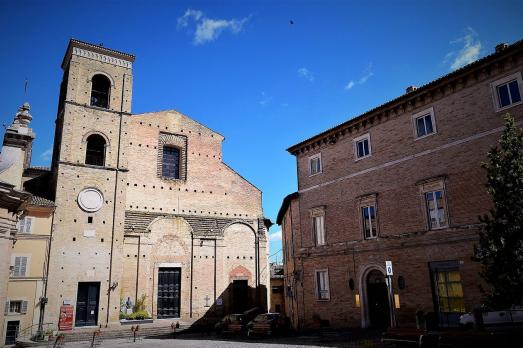
Macerata Cathedral

Macerata Cathedral

Macerata, IT

The cathedral of Macerata has been known since the 10th century. Before the construction of the present cathedral, there was a small rural church dedicated to San Giuliano, built in 1022. Between the 14th and 15th centuries, a second building was erected next to the church, completed in 1478 with the construction of the bell tower, still visible today, in Flamboyant Gothic style. The two existing buildings were united to form a single neoclassical cathedral in 1771.

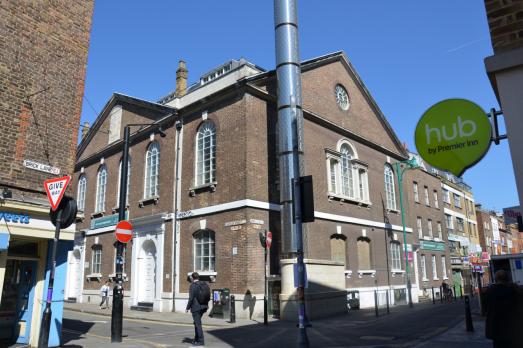
Machzike Hadath Synagogue

Machzike Hadath Synagogue

London, GB

The Machzike Hadath (Spitalfields Great) Synagogue in London is an Ashkenazi synagogue built in 1742-43 by architect Thomas Stubbs as the ‘New French Church’. It was rebuilt in 1897 by A.J. Hopkins and in 1957. This brick building in the Georgian style now serves as a mosque.

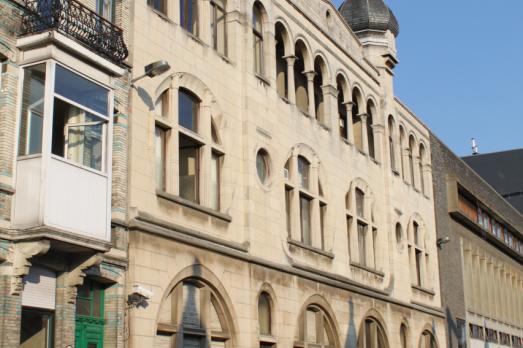
Machzikei Hadat Orthodox Synagogue in Antwerpen

Machzikei Hadat Orthodox Synagogue in Antwerpen

Antwerpen, BE

The Machzikei Hadat Orthodox (Great) Synagogue in Antwerp is an Orthodox synagogue built between 1910 and 1914 by the architect Jules Hofman. This brick building in the National Romantic style still serves as a synagogue.

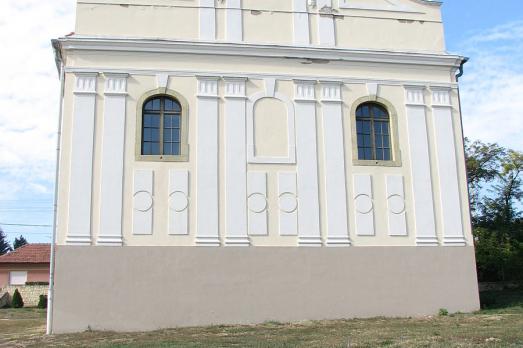
Mád Synagogue

Mád Synagogue

Mád, HU

The Synagogue in Mad was built in 1795 in a baroque style, and the interior is well decorated with Polish-Lithuanian influences. Restoration of the building was completed in 2004 and the building is now used for concerts, conferences, and other events.

Be inspired

Stupkalnis.lt

10 Buddhist stupas to discover in Europe

Stupas are symbols of enlightenment and peace that commemorate different stages of Buddha's life. Since the mid-20th century, thousands of stupas have begun to populate Europe. We have compiled some of the most impressive ones in this list.