Explore Religious Heritage Across Europe

Here you can search for a building to visit. You can use the map find destinations, or you can use the filters to search for a building based upon what different criteria.

Refine search

Marthakerk

Raard, NL

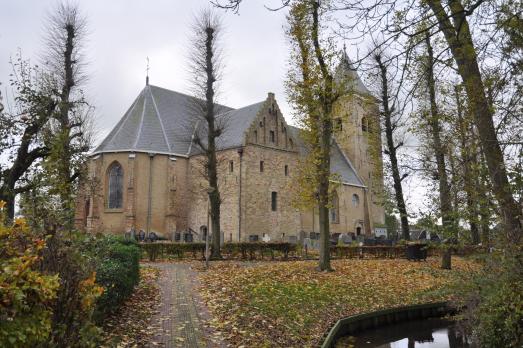
Raard or Rauwerd (West-Dongeradeel) is located on the border of West- and Oost-Dongeradeel. The village coat of arms features the cross banner, the symbol of the old church patron, John the Baptist. The village is located on a mound on the road from Holwerd to Dokkum at the Hooge- or Klaarkampsterbrug and near the Holwerder-vaart. The population, as far as Reformed or Reformed (synodal), belongs to the federal SOW municipality of Foudgum/ Bornwird/ Raard. This municipality has two church buildings, the Reformed Church in Foudgum and the Reformed Church in Raard. The Reformed Churches in Raard and Bornwird were sold off in the context of the formation of the SOW municipality and transferred to the Stichting Alde Fryske Tsjerken in 1979. Nowadays, services are held alternately in Raard and Foudgum. The first Reformed Church in Raard was built in 1893, probably shortly after the establishment of the Reformed community there. This church was replaced in 1918 by the current one, probably at the same location outside the village. It is a straight-closed hall church with a facade tower, portal and some Berlagian features (flat wall treatment, emphasis of the structurally important parts by means of natural stone blocks, round-arched windows). The spatial effect is characteristic of the smaller Reformed church buildings from that period. Several outbuildings have been added to the east and south-east side of the church, which is otherwise in a good state of repair, used for childcare, meetings and as storage space. The Reformed Church of Raard (until around 1913 Foudgum ca) had its own minister from 1897 to 1998. Since 1987 it has been shared with the Reformed Foudgum in the federal SOW community. The federated SOW congregation of Foudgum/Bornwird/Raard currently shares a (Reformed) minister (Rev. JP Boomsma) with neighboring Hantum.

Martin Luther Cathedral

Martin Luther Cathedral

Daugavpils, LV

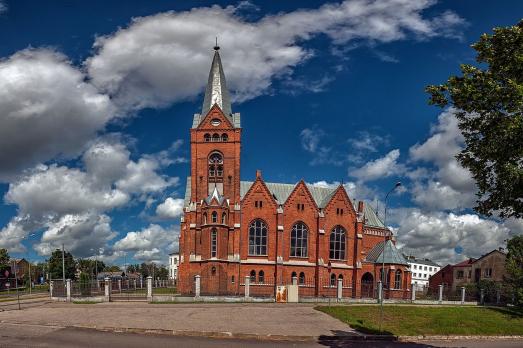
The Martin Luther Cathedral is the Evangelical Lutheran Cathedral in Daugavpils. It was built in 1892-93 from red bricks in the neo-gothic style according to the design of the architect Wilhelm Neumann. At the end of June 1941, during the Wehrmacht attack, the retreating Red Army set fire to the church. The spire of the church tower, the window frames and the wooden interior burned down. After the war, the church became a depot, a repair factory and then a sports school. The restoration of the church was undertaken between 1990 and 2005.

Martin-Luther-Kirche

Martin-Luther-Kirche

Dresden, DE

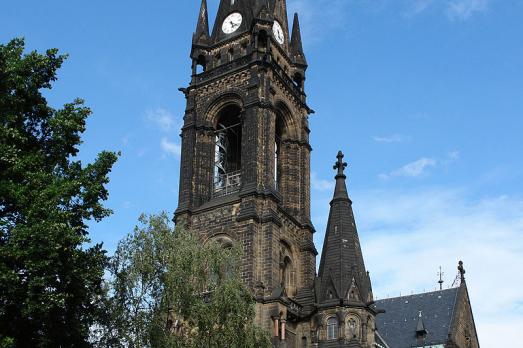
The Martin Luther Church in the Dresden Neustadt is a church built in the late 19th century. It stands on the Martin Luther Square built in the same period. The building marries neo-Romanesque (especially in its interior) with neo-Gothic elements (mostly exterior).

Martinikerk

Koudum, NL

This church, built in 1857, has one of the most beautiful church interiors in Friesland. This 17th-century interior comes from the former cruciform church of 1614 and includes a pulpit from 1648 with Aylva-Walta coats of arms, pews with carved end partitions and ball crownings, a memorial plaque from 1580 and beautiful copper work. The church also contains a single-manual organ from 1858 with organ pipes from the old Bader organ. In 2002, the roof was restored with the support of the village, government and funds.

Martinikerk

Itens, NL

Reformed Church on enclosed churchyard. In the church 17th century pulpit with cornice panels and two 19th century text boards. Organ made in 1876 by W. Hardorff. In the roof turret a bell by Stephanus, 1312, diam. 95 cm. Mechanical tower clock S. Rodenburg, Sneek, first quarter 20th century

Martinikerk

Franeker, NL

Reformed Church. Spacious three-aisled pseudo-basilica, the side aisles of which continue as an ambulatory around the choir, covered by wooden vaults. Entrance gate on the east side with a head as a keystone and crowned with a cartouche around the coat of arms of the city, held by two female figures as tenants. (1647). Internal brick railing around the choir, 15th century. Wall paintings on the pillars. Large number of tombstones, some of which are upright in the choir and including very beautiful 16th-18th century examples.

Martinikerk

Sneek, NL

Reformed Church. Three-aisled late Gothic church, initially built against a Romanesque west section, which collapsed in 1681 and was then replaced by a three-sided closure. Roof renewed in 1709; bell dome 1709. On the south side 16th century sacristy, with panelling and ceiling 1759; accessible through Gothic door. Interior: pulpit 1626. Coats of arms. The bell by S. Butendiic, 1466, diam. 102 cm. was transferred to the freestanding bell house during the restoration of the modern carillon. Mechanical tower clock B. Eijsbouts, Asten, first quarter 20th century, later fitted with electric winding. Drum playing mechanism by Eijsbouts, ca. 1930.

Martinikerk

Groningen, NL

The Martinikerk is the main church of the city of Groningen. During excavations during the last restoration, remains were found in the nave, which indicate a first wooden church around the year 800. Around the year 1000, the first stone church was located at the Martinikerkhof. This was a single-aisled Romanesque church made of tuff. Remains of this were also found during the last restoration. The church originated from a three-aisled cruciform church from the 13th century, which was enlarged and extended westwards in the 15th-16th century and provided with a new choir with ambulatory in 1450-1460. On the north side of the choir, a two-aisled chapel with a floor and sacristy. Nave and choir completely vaulted in stone.

Martinikerk

Martinikerk

Easterein, NL

Reformed Church and Tower on moated churchyard. The Martini Church has the nickname “Cathedral among Frisian Village Churches”. The church with tower from 1688 is completely moated.

Martinskirche

Martinskirche

Kassel, DE

The Martinskirche was founded in the 14th century and consecrated in 1462. From 1524, when Landgrave Philipp converted to the Protestant faith, the church was Protestant. The cloister, which housed the city's Latin school from 1539-1776, was demolished in 1776-77 due to the threat of collapse. From the beginning of the 16th century until the end of the 18th century, the landgraves of Hesse were buried here.

Be inspired

Stupkalnis.lt

10 Buddhist stupas to discover in Europe

Stupas are symbols of enlightenment and peace that commemorate different stages of Buddha's life. Since the mid-20th century, thousands of stupas have begun to populate Europe. We have compiled some of the most impressive ones in this list.