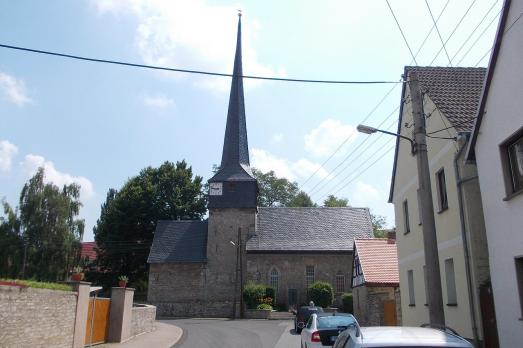
Village church
Heerlen, NL
Simple church without tower. Various renovations. This church was in service until Sunday 15 November 2015. Then the church was closed for worship. The members of Heerlen are included in the municipality of Kerkrade.
Here you can search for a building to visit. You can use the map find destinations, or you can use the filters to search for a building based upon what different criteria.
Heerlen, NL
Simple church without tower. Various renovations. This church was in service until Sunday 15 November 2015. Then the church was closed for worship. The members of Heerlen are included in the municipality of Kerkrade.
Durgerdam, NL
Small village church with tower. The Dorpskerk Durgerdam, originally the Hervormde kerk van Durgerdam, is the Protestant church in Durgerdam in Amsterdam-Noord. The church building is not along the Durgerdammerdijk, but a little lower behind it.
Heemskerk, NL
This church was first mentioned in 1063. It is unknown what it looked like. Over the centuries, a church was built of tuff, a grey volcanic stone from the Eifel, on the site of the current one. The tower was built in the 13th century from the so-called monastery bricks, these are large baked bricks that were used to build monasteries. The tower, built in Gothic style, probably originated in the first half of the fifteenth century. This can be deduced from the year 1464 on the bell. Just like the church, the bell was dedicated to Saint Laurentius. The bell had a social warning function. In the event of a storm, fire or other danger, the population was called to help or warned by ringing the bell. During the siege of Alkmaar in 1573, the Spanish demolished everything that was flammable from the church. Only the tower remained intact. In the meantime, the Reformation had taken place. After the departure of the Spanish soldiers, the reconstruction by the Protestants began. It became a hall church without a choir in Gothic style. The church was rebuilt in 1628. A year later the church was completely finished. Since 1798 the tower has been municipal property. In 1970-1971 the tower and the church were restored
Hendrik-Ido-Ambacht, NL
Original building from 1968. Major renovation and extension in 1999, with turret on roof. Municipality founded in 1953.
Sellingen, NL
Historic village church with tower from 1858. Excavations during a restoration showed that there was already a wooden predecessor to this current church. The earliest mention of a church in Sellingen dates from 1150 in a list of churches of the Corvey Abbey in the Osnabrück diocese. During the aforementioned restoration, the National Institute for Archaeological Heritage Research uncovered about 20 old graves, two of which date from around 1100. There are probably more graves present, but due to lack of money, not the entire church floor was excavated at the time. A gravestone can still be found in the churchyard. (Source [1]
Leiden, NL
Built as a Reformed Church. Church building without a tower, with, among other things, windows in neo-Gothic style. Replaced an earlier church hall from 1854. Restoration 1903. Out of use as a Reformed Church in 1957, when it was taken over by the Reformed Church (Liberated). After the merger in 2023, it became the NGK.
Doornspijk, NL
Neoclassical church with tower. Extensions in 1950 and 1996. Since 2004 also in shared use as a Reformed Reformed Church.
Nieuw-Lekkerland, NL
Church building, because of the organ, a pulpit, a baptismal fence and a pew in it. The church building was built in 1847-1848 to a design by D. Slingerland from Meerkerk on the site of an older predecessor. The church was expanded several times in later times, most recently in 1994, when the layout in the church was changed. The inventory mentioned is partly from the predecessor of the current church, which dates from 1646 and was built on the site of a burnt-down church from the 15th century. The organ and the pew were added in the 19th century by order of the lords of the manor Smit from Nieuw-Lekkerland. In addition to the parts that are worthy of protection by the state, the church building also contains five 17th-century gravestones, three copper church crowns, which have been modified and partly renewed, and 12 cast-iron wall fixtures (1881). The protection does not apply to these parts.
Weimar, DE
The village church of Gelmeroda was built from the 13th century. At the beginning of the 13th century, the oldest part of the choir tower church was built. The nave was built in the 14-15th century and rebuilt later. During the GDR era, the church was abandoned. The citizens of the village and the surrounding area became active as members of an association and saved the building from decay. After extensive renovation work, the church was consecrated again in 1991 and in 1994 it became the first church in the new Länder to be granted the status of a motorway church.
Villers-la-Ville, BE
Villers Abbey was founded in 1146 by Bernard de Clairvaux and was one of the first "daughters" of the Abbey of Clairvaux. After a period of decline from the 14th to the 17th century, the abbey experienced a second golden age in the 18th century when some of its buildings were refurbished in the neoclassical style (facades of the church and the convent building). Sacked by the French Revolution and then confiscated by it as national property, its monks were then expelled and its estate sold in lots.
new
For a long time, Europe was ruled by powerful monarchies. Monarchy and religion have been connected since time immemorial. Here are 7 sites across Europe where royalty historically bent the knee to a higher power and received their crown.
Stupas are symbols of enlightenment and peace that commemorate different stages of Buddha's life. Since the mid-20th century, thousands of stupas have begun to populate Europe. We have compiled some of the most impressive ones in this list.
Walter Maria Förderer (1928–2006) was a Swiss architect and sculptor renowned for his neo-expressionist church designs in the 1960s. In this list we have compiled 6 of his church designs that seamlessly integrate religious and secular elements.