
Explore Religious Heritage Across Europe

Here you can search for a building to visit. You can use the map find destinations, or you can use the filters to search for a building based upon what different criteria.

Refine search

Dorpskerk

Rockanje, NL

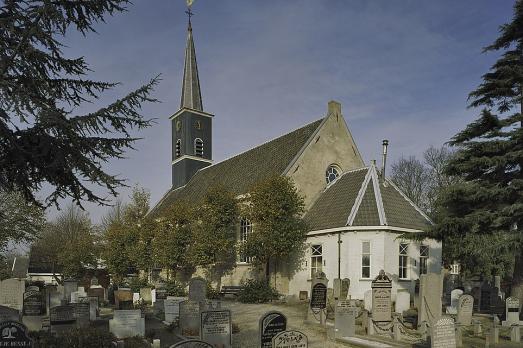
Reformed church. Single-nave nave with narrower, rectangular closed choir (16th century). Oak tie beams with corbels and key pieces with pear bead profiles. Inventory: simple pulpit (19th century?), four gentlemen's pews (18th century). Organ made in 1884 by Gebr. van Oeckelen.
Dorpskerk

Blokker, NL

It is not known when a church first stood on this site, but it is known that there was a parish in Westerblokker around 1513. It is not possible to say with 100% certainty what style the church had, but on the basis of several drawings and engravings it can be stated that the church at least has stylistic features of a late Gothic church from the first quarter of the 16th century. This church, more precisely the nave, was demolished in 1830 due to dilapidation. The new nave was widened in 1864 at the height of the two easternmost bays and the choir enclosure. The current cast iron windows also date from that renovation. In 1883 the, also, cast iron entrance and ornamental gates were added. The pillars of the gate on the Westerblokker show the year 1883.

Dorpskerk

s-Gravenzande, NL

Reformed Church. Originally an octagonal building with a mansard roof and a domed roof turret, built in 1815-1816 to a design by A. Tollus. Founded by a donation from King William I. Enlarged in 1850 to a rectangular space, retaining three sides of the original design. The interior was thoroughly modernised in 1958. Organ with two manuals and pedal by Bakker and Timmenga (Leeuwarden) from 1899. Mechanical tower clock of French make, first quarter of the 20th century.

Dorpskerk

Oud-Beijerland, NL

This church is listed as a National Monument of the Netherlands.

Dorpskerk

Biggekerke, NL

The church of Biggekerke is known to have been founded before 1247 as a daughter church of the Westmonster church in Middelburg. Until 1453, there were even two pastors' positions attached to it. During the Reformation, it also caused quite a stir here. The pastor at the time, Bernard Donder, was a convinced Calvinist and renounced the Roman Catholic church in 1566. Since then, he has also preached the Reformation in Biggekerke, something for which he had to pay with imprisonment. After being released and imprisoned several times, he fled to England or Germany. After this, a period began in which people could only meet secretly and in small numbers, in someone's house. But then, when Middelburg declared itself loyal to Orange, the Reformation could develop. At that time, there was still the problem that there were too few pastors, but in 1583, the classis of Walcheren assigned the first pastor to Biggekerke, the Rev. J. van Aecken.

Dorpskerk

Driewegen, NL

Dutch Reformed Church. Rectangular hall church, altered internally and externally in 1914, but mainly preserved in the form in which it was founded in 1678. Stately brick facade, decorated with natural stone carvings. Roof turret above the front facade. Internally sculpted pulpit, dated 1679. Entrance to the church grounds flanked by brick pillars with shield-bearing lions, coats of arms of Driewegen and Coudorpe. Bell tower with bell by Nicolaas Muller, 1734, diam. 70 cm. Mechanical tower clock, F. van de Kerkhof, 1906.

Dorpskerk

Nunspeet, NL

As early as the 12th century, a stone church must have stood on the site of the village church. Before that, there was probably a thatched wooden church. The church was dedicated to Saint Anthony. On 6 June 1855, the church burned down. A large fire destroyed part of the church and also a large number of the village houses, only a part of the church tower was preserved. In 1857, new construction began. In 1949, three new bells were cast, replacing the two previous bells. They weighed 650, 371 and 260 kilos respectively and sounded in G sharp, B and C sharp. The middle bell was replaced in 1961 after a crack. The inscriptions read according to bells:

Dorpskerk

Beetsterzwaag, NL

In the church under the organ gallery hangs the certificate of the union of the Reformed Church and the Reformed Church, September 17, 1997, when the Samen op Weg community Via Pacis - the way of peace - in Beetsterzwaag was called Olterterp. Now the Protestant community Via Pacis. This church is still regularly used for evening services and special services. The community holds the morning services in De Ontmoetingskerk (the former Reformed Church).

Dorpskerk

Ruurlo, NL

Dutch Reformed Church (before Reformation: St. Willibrord or Our Lady Church). Originally a 14th century church with a tower (15th c). The Gothic northern aisle was replaced in 1845 by a new aisle. The nave and choir are covered by cross-ribbed vaults, which in the nave and part of the choir start from wall pillars, connected by mural arches. Inventory: pulpit (17th) and clock by Arent vd Put in Deventer, 1600. On the northeast corner stone 1845. Organ with main work and lower positive, made in 1840 by JH Holtgräve, restored in 1983 by the Gebr. Reil.

Dorpskerk

Dorpskerk

Akersloot, NL

The Dorpskek in Akersloot was originally erected in the 13th century on the foundations of a Romanesque church. The current building is the reconstruction of 1837 as the previous building had to be demolished due to its deterioration.

Be inspired

Stupkalnis.lt

10 Buddhist stupas to discover in Europe

Stupas are symbols of enlightenment and peace that commemorate different stages of Buddha's life. Since the mid-20th century, thousands of stupas have begun to populate Europe. We have compiled some of the most impressive ones in this list.