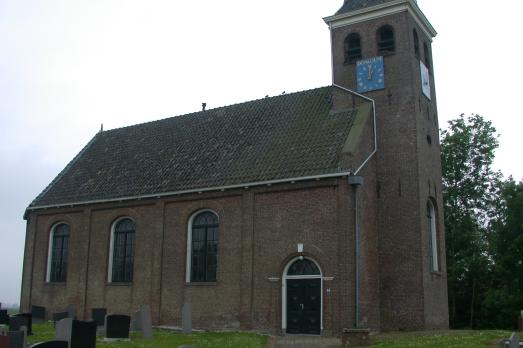
Hervormde Kerk
Dongjum, NL
Reformed Church and tower on churchyard. In 1777 rebuilt brick church with tower.

Here you can search for a building to visit. You can use the map find destinations, or you can use the filters to search for a building based upon what different criteria.
Dongjum, NL
Reformed Church and tower on churchyard. In 1777 rebuilt brick church with tower.
Kloosterhaar, NL
The church replaced a smaller church from 1892. Striking and quite rare example of reformed church building from the reconstruction period in traditionalist forms.
Giessen, NL
The history of the church in Giessen goes back to the 11th century. During a study between 1958 and 1960, foundation remains of a tuff stone hall church of 16 x 8 metres were found on the east side, adjacent to the church. Due to flooding in 1275, the western part of the church was washed away and the building collapsed. Approximately eleven years later, in 1286, reconstruction began, with the nave being given the same dimensions. The remaining part of the foundation was used for this. In addition, a three-sided closed choir was built onto the nave. Some time later, a transept chapel was added to the northern side.
Langezwaag, NL
Reformed church and tower on churchyard. Simple church building with built-in tower 1781. In the church richly carved pulpit with back wall and sounding board; lectern 17th century communion table. Seven carved gravestones, three 17th century and four 18th century. Organ case and front by H. Knipscheer from 1866. Knipscheer used an old four-foot front that was extended on both sides. Mechanical tower clock by Bergen, Midwolda, 1923, no. 1236.
Stavenisse, NL
NH Church from 1910, placed on the list of monuments because of interior components: Tomb monument of Tuyl van Serooskerken (approx. 1670) made by Rombout Verhulst. Tomb with reclining figure, the back wall decorated with quarters and putti. Pulpit with Ionic pilasters on the corners of the bowl. XVIId. Reader's pew and regent's bench from the same period.
Bleskensgraaf, NL
Gothicized single-nave church with tower and narrowed liturgical centre, built in 1948 by G. van Hoogevest. Internal wooden barrel vaults between brick belt arches. Some furniture from the previous church, destroyed in 1940.
Ouwsterhaule, NL
Historic village church with an extensive construction and renovation history.
Ried, NL
Ried (Rhede) borders the old monastery Anjum in the east, belonging to Menaldumadeel. In the past, noble states such as Anema, northeast of the village, still visible on the canals and court, Oud-Andla, southwest of the castle which was demolished in 1433, and Nieuw-Andla were located here.
Genderen, NL
Dutch Reformed Church. Of this building, only the tufa substructure of the tower, the interior of which is covered with a dome vault, should be considered a monument; 13th century. Restored in 1953 after the destruction of the church and the tower in 1944.
Elahuizen, NL
Dutch Reformed Church, national monument because of the single-manual organ, made in 1865 by W. Hardorff in Leeuwarden.

new
For a long time, Europe was ruled by powerful monarchies. Monarchy and religion have been connected since time immemorial. Here are 7 sites across Europe where royalty historically bent the knee to a higher power and received their crown.

Stupas are symbols of enlightenment and peace that commemorate different stages of Buddha's life. Since the mid-20th century, thousands of stupas have begun to populate Europe. We have compiled some of the most impressive ones in this list.

Walter Maria Förderer (1928–2006) was a Swiss architect and sculptor renowned for his neo-expressionist church designs in the 1960s. In this list we have compiled 6 of his church designs that seamlessly integrate religious and secular elements.

How is Religiana helping to conserve and promote Religious Heritage in Europe and why should you get involved?
Find out about Religiana
Are you a tourism organisation or religious heritage sites manager? Discover the advantages of becoming a partner.
See current partners
We can keep you up to date with the latest news from Religiana and religious heritage conservation across Europe.
Sign up to the FRH newsletter