Hervormde Kerk
Colijnsplaat, NL
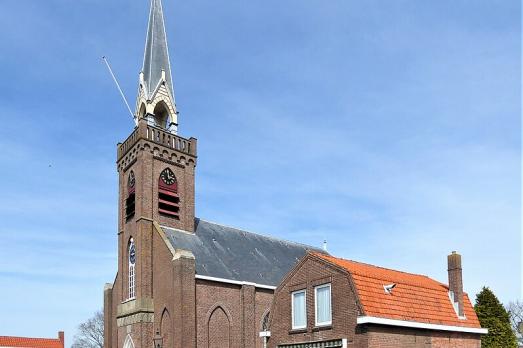
Hall church with tower. Built as a Reformed church. Enlarged 1615, rebuilt 1769.

Here you can search for a building to visit. You can use the map find destinations, or you can use the filters to search for a building based upon what different criteria.
Colijnsplaat, NL
Hall church with tower. Built as a Reformed church. Enlarged 1615, rebuilt 1769.
Oosterwolde, NL
This church is listed as a National Monument of the Netherlands.
Langweer, NL
Reformed Church and Tower. At the western end of the old centre on a fenced churchyard, spacious single-nave church building with tower from 1777. Pilasters on choir closure, west facade and lower tower section; second and third tower section with Ionic and Corinthian pilasters respectively. Above the church entrance, carved window. In the church, oak pulpit from 1684 with back wall and sounding board; baptismal fence with twisted balusters and festoons; oak ball-leg table. Canopied lord's pew; two non-canopied pews; twelve pews with carved end walls. Organ with main work and back work, made in 1784 by Lambertus van Dam on organ balcony with parapet, including back wall with carved panels, all 1784. Copper crown. On the pews, large number of copper candlesticks. Under the wooden floor, number of tombstones. Bell frame with the sound of two bells, one by J. de Bomen, 1438?, diam. 96 cm. and one by P. Overney, 1683, diam. 91 cm. Mechanical tower clock, 18th century.
Est, NL
Late neo-Gothic church with historic tower.
Beusichem, NL
Three-aisled pseudo-basilica with five-sided closed choir from the 15th century with a tower of which the lower four sections are still 12th century. Internal wooden barrel vaults. Replaced an older church. Beautiful tuff stone tower (ca. 1200) of the Reformed Church, raised with a brick floor in the Gothic period.
s-Gravenmoer, NL
Dutch Reformed Church. Since changes after destruction by the French in 1672 consisting of a three-sided closed choir of two bays, from the 15th century, two low, 15th century, shortened in the 19th century, transepts, a 15th century nave of five bays, enlarged around 1500 with a north aisle and a built-in 14th century tower with buttresses on the west side, an arched frieze under the spire and a vault over the lower space. Internal columns with molding capitals and wooden barrel vaults. Restoration completed in 1963. Oak pulpit, baptismal fence and associated copper work from 1680, replaced. 17th and 18th century tombstones. Mechanical wrought iron tower clock by Juriaan van Zutphen, 1695, electric winding.
Hierden, NL
Although the H. Severinus chapel stood here around 1350, the current church was only built around 1850. An old schoolroom from 1658 was converted into a church in 1851. This created a hall church with barrel vaults. The addition of two side wings with portals in 1937 changed this design. The front facade has two pointed arch windows and a round window. Striking is the climbing arch frieze in which pointed arches and entire circle shapes are also incorporated, as well as the clock face. The facade is crowned with a small bell tower.
Arnemuiden, NL
The chronicler Reigersberg writes that on 9 May 1505 the first stone was laid for a new church, a cruciform church. That church was put into use in 1545 and dedicated to Saint Martin.
Nieuw-Balinge, NL
Reconstruction church with turret and roof turret.
Hei- en Boeicop, NL
Single-nave church with a bell tower on the church roof. The church was founded around 1300 and expanded in the 15th and 16th centuries. The remaining lower part of the original tower is part of the church space. In the 19th century, the late Gothic choir closure was replaced by a straight wall, so that two bays of the choir remain. Wooden barrel vaults; in the choir wall posts with ornament in early Renaissance forms. Inventory: pulpit from the second quarter of the 17th century, a lord's pew with arch panels, 17th century and a lord's pew in Louis XV style; three painted text boards, 17th century and tombstones from the 16th and 17th centuries, silver baptismal font (1806) and two communion cups dating from 1741 (Jacob Visbach).

new
For a long time, Europe was ruled by powerful monarchies. Monarchy and religion have been connected since time immemorial. Here are 7 sites across Europe where royalty historically bent the knee to a higher power and received their crown.

Stupas are symbols of enlightenment and peace that commemorate different stages of Buddha's life. Since the mid-20th century, thousands of stupas have begun to populate Europe. We have compiled some of the most impressive ones in this list.

Walter Maria Förderer (1928–2006) was a Swiss architect and sculptor renowned for his neo-expressionist church designs in the 1960s. In this list we have compiled 6 of his church designs that seamlessly integrate religious and secular elements.

How is Religiana helping to conserve and promote Religious Heritage in Europe and why should you get involved?
Find out about Religiana
Are you a tourism organisation or religious heritage sites manager? Discover the advantages of becoming a partner.
See current partners
We can keep you up to date with the latest news from Religiana and religious heritage conservation across Europe.
Sign up to the FRH newsletter