
Explore Religious Heritage Across Europe

Here you can search for a building to visit. You can use the map find destinations, or you can use the filters to search for a building based upon what different criteria.

Refine search

Hervormde Kerk

Hervormde Kerk

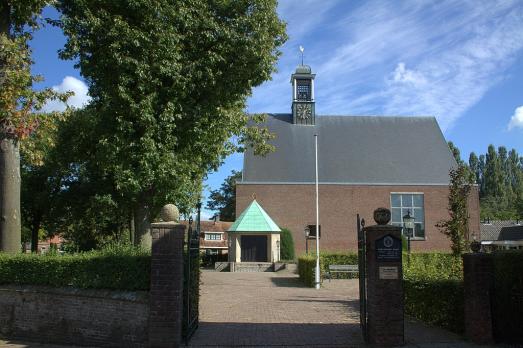
Almkerk, NL

Hall church with roof turret in traditionalist forms, built in 1950 to a design by the architects Chr. Nielsen and JHC Spruit from Amsterdam to replace a medieval church that was largely destroyed in 1944. The gables are open-worked as windows. Internally visible roofing. Some mourning boards have been preserved from the old inventory, as well as the Adema organ from 1877.
Hervormde Kerk

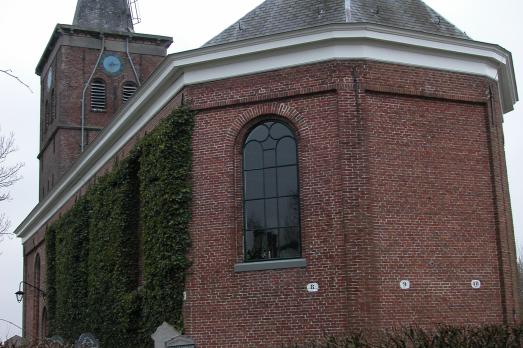
Sint-Kruis, NL

In 1296, a parish in Sint Kruis was first mentioned, which was subordinate to the Ter Doest Abbey. Due to flooding, partly as a result of the Geuzen breaching the dikes in 1584 to stop the Spanish troops, the area was flooded and was not drained again until 1651. The current church building dates largely from the 14th century and initially consisted of a single-nave church with a tower. In 1467 and 1483, the church was enlarged to a three-nave church with a choir and transept. This church was badly damaged during the Dutch Revolt, but in 1652 it was restored to serve as a Reformed church building. What remained was a single-nave church with a straight-ended nave and the tower. Another renovation took place in 1872. In 1944, the church was badly damaged by war violence and was restored in 1948-1949.

Hervormde Kerk

Bruinisse, NL

Interesting reconstruction church with roof turret. Replaced a historic church destroyed by war.

Hervormde Kerk

Lekkum, NL

The former reformed church of Tijnje is a simple hall church without a tower built around 1890 or in 1907-1908: the exact year of complete construction is not clear. The straight-closed church building was originally built of brown brick, but the walls were all plastered at a later stage.

Hervormde Kerk

Drimmelen, NL

Dutch Reformed Church. Founded in 1792 by Jonkvrouw van Doorn, Lady of Drimmelen (commemorated in a stone above the entrance, with coat of arms), to replace the church in Oud-Drimmelen. Hall church, closed on three sides at the short ends; arched windows; high slate roof with roof turret. Internal wooden wall pilasters and wooden barrel vault with two rosettes with mermaids. Adjoining parsonage from the time of construction. Iron entrance gate between two bluestone pillars also from the time of construction. 18th century copper lecterns and baptismal font holder. Restored in 1965.

Hervormde Kerk

Sint Annaland, NL

Large church with tower of the Reformed Church of Sint Annaland. Reformed Federation signature.

Hervormde Kerk

Oude-Tonge, NL

The church building is a late Gothic church, built in the 15th century. In a deed of approval dated 8 November 1499, the Bishop of Utrecht, Frederik van Baden, confirmed the foundation of the church by the Ambachtsheren. The oldest part of the current church is the choir with the sacristy, the current consistory or church council room. There must have been a cruciform church dedicated to Mary here as early as around 1468. In the choir there is still a gravestone from 1492 of one of the dike builders of Grijsoord, the polder in which the village of Oude Tonge is located. The main nave therefore dates from 1499. Shortly afterwards, in the first half of the 16th century, a major renovation took place: the choir and the sacristy remained unchanged, but the existing nave was enlarged in a westerly direction, with a tower being partially built in and extended with a north nave. In 1742, a portal was built on the south side of the main nave, with a facade stone above the entrance stating the year of construction. By order of the French occupiers, the tower was robbed of its crowning (an onion-shaped spire) in 1812. The resulting tower slab was used as a telegraph facility. Later, the municipality placed a small bell tower on top, with another “onion” with a spire on top. Various 'modernisations' of the church building resulted in little remaining of the original condition. In 1831, the 'church interior was attractively embellished', and the floor was also restored. Church services were then temporarily held in the choir. Later, the floor of the choir was also 'renewed with blue bricks'. Another very drastic renovation took place in 1854, when a church council floor was constructed in the choir. (Source: Website church community )

Hervormde Kerk

Hervormde Kerk

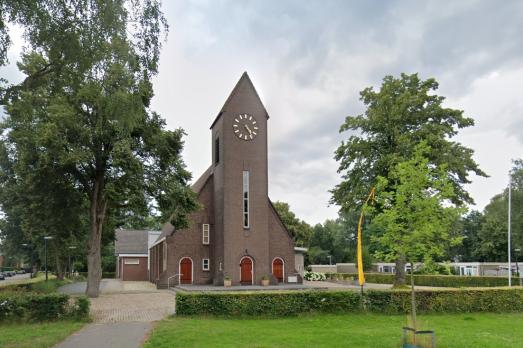
Apeldoorn, NL

Due to the strong growth, especially on the western side of Apeldoorn and the associated increase in the number of inhabitants, the Reformed Church built a new church on the Asselsestraat in 1934.

Hervormde Kerk

Langweer, NL

Reformed Church and Tower. At the western end of the old centre on a fenced churchyard, spacious single-nave church building with tower from 1777. Pilasters on choir closure, west facade and lower tower section; second and third tower section with Ionic and Corinthian pilasters respectively. Above the church entrance, carved window. In the church, oak pulpit from 1684 with back wall and sounding board; baptismal fence with twisted balusters and festoons; oak ball-leg table. Canopied lord's pew; two non-canopied pews; twelve pews with carved end walls. Organ with main work and back work, made in 1784 by Lambertus van Dam on organ balcony with parapet, including back wall with carved panels, all 1784. Copper crown. On the pews, large number of copper candlesticks. Under the wooden floor, number of tombstones. Bell frame with the sound of two bells, one by J. de Bomen, 1438?, diam. 96 cm. and one by P. Overney, 1683, diam. 91 cm. Mechanical tower clock, 18th century.

Hervormde Kerk

Hervormde Kerk

Engelum, NL

In its current form, the church of Engelum is a three-sided closed hall church with a tower of three sections with a constricted spire. The tower, which is not accessible from the church, was sheathed in 1887 and is said to still have thirteenth-century masonry from the original church. According to the memorial stone in the south wall of the tower (inv. no. 16), the rest of the church was also renovated in 1887. Incidentally, the nave and choir were said to have been rebuilt in 1773.

Be inspired

Stupkalnis.lt

10 Buddhist stupas to discover in Europe

Stupas are symbols of enlightenment and peace that commemorate different stages of Buddha's life. Since the mid-20th century, thousands of stupas have begun to populate Europe. We have compiled some of the most impressive ones in this list.